Saturday, August 9, 2014

Supernatural

What is supernatural?

Love is supernatural. Laying down one's life, going out of your way to give help to someone underserving - that's supernatural. That's amazing. That's what shakes principalities and powers.


What is supernatural? Jesus coming down to earth, humbling Himself and taking on human form. That is supernatural obedience, coming from the supernatural grace of God.

God's love is supernatural. It is supernatural to be unselfish, supernatural to forgive despite being wronged, supernatural to stick out your neck for someone else, someone you

It is supernatural to admit you made a mistake and ask for forgiveness.

It is supernatural to be kind to the least estimable, to the weak, to the undeserving, to the downtrodden.

It is supernatural to cling to faith and continue to hope in the face of the greatest despair.


Those things are some of what the Bible teaches us is "supernatural", beyond what we naturally are as humans - at best complacent, at the least actively destructive. I know there are many things about the "spirit world" that I do not understand, and beyond what the Bible explicitly teaches, I feel I do not need to - the great, awesome, physics-defying feats I believe to be God's business and God's prerogative, not gimmicks for me to employ.

 I feel what I should focus on is what the Bible reiterates again and again, because I believe in the love, mercy, forgiveness, and kindness of God, and I believe that when we are His instruments in these, we are privileged to be engaging in the "supernatural".

Ramblings on "Rewards"

Humans are made with an innate sense of justice. We want right to be repaid with right, wrong with wrong. This is common in all religions and is the basis of ethics. It is natural to want to right to be rewarded, wrongs to be punished. Whether it is the concept of "operant conditioning" or "karma", this is a basic belief that almost everybody shares.

But after thy hardness and impenitent heart treasurest up unto thyself wrath against the day of wrath and revelation of the righteous judgment of God; Who will render to every man according to his deeds: To them who by patient continuance in well doing seek for glory and honour and immortality, eternal life: But unto them that are contentious, and do not obey the truth, but obey unrighteousness, indignation and wrath,
(Rom 2:5-8)

I believe in that - we all should believe in that. No matter what we believe about salvation, we know that God does not reward evil, that our actions have consequences, that true good works are, after all product of faith. I don't believe that spirituality means anything that deviates from spiritual behaviour, the qualities and "fruits of the Holy Spirit" such as love, joy, peace, patience, etc. etc.

We cannot promote a warped view common in Christianity that tries to undo this basic, fundamental, principle of right and wrong. It is not by negating this idea that we come to the miracle of salvation, but rather building upon it.

Salvation from this viewpoint is this: We all have sinned and deserve to be punished. Sin = evil. Evil = punishment. Why? Because we do harm to this earth and we do harm to others. Even if we are good, we cannot be perfect. Humanity is a hopeless case in that our good deeds can never outweigh or negate our bad deeds, because deep inside, we are all filthy and selfish and despicable. We have evil thoughts, evil desires, and every day of our lives as humans we do harm. Thus, all we deserve is eternal punishment.

However, God chose to do something miraculous, something outside of the bounds of duty or reward. He chose to do the extraordinary, to show incredible favour, he chose to save us. God rescuing and saving the sinner does not validate the sinner's evil but rather serves to emphasize the forbearance of God.

We like to think salvation removes the principle of justice completely. To me it does not - the works of a believer are the most telling, and wrong is wrong whether it is committed by a so-called Christian or a person who does not subscribe to the Christian religion.

And, behold, I come quickly; and my reward is with me, to give every man according as his work shall be.
(Rev 22:12)

"Boo hoo," you might say, "How can the Bible say something so unjust and legalistic as to  say hat God rewards people according to their works? Does He not save by grace and cease to judge?"

"No," I say, "Somehow, the same Bible that proclaims that we are saved despite our works, also tells us that without good works our beliefs are invalid, and that God will eventually reward each man according to his deeds. And, unless we can reconcile those truths of Scripture, navigating the narrow path that avoids the pitfalls of oversimplification or mindless rhetoric, we do not truly know what the Bible is saying."

Blessed are they that do his commandments, that they may have right to the tree of life, and may enter in through the gates into the city. For without are dogs, and sorcerers, and whoremongers, and murderers, and idolaters, and whosoever loveth and maketh a lie.
(Rev 22:14-15)


My  belief is that the New Covenant is not so very radical, so very unlike the "old" as to be completely estranged from it. What changes in the New Covenant is not God's righteousness, justice, or nature. It is we who are altered, not God. It is upon our hearts that God has written the law, that we might for the first time be able to walk in accordance to His plan. It is the weaknesses of humanity that is abolished and removed, not the perfect law of God, the law of liberty. The Law of God will never be abolished, for that would be akin to destroying the nature of God. It is not God who relaxes His standards but we who are, beyond the highest of our capabilities, transformed into new creatures and endowed with the perfection of Christ.

And to her was granted that she should be arrayed in fine linen, clean and white: for the fine linen is the righteousness of saints.
(Rev 19:8)

To me, right-being cannot be divorced from right-doing. A good tree produces good fruit, the Bible teaches. A good tree cannot produce bad fruit nor a bad tree good fruit. 'Nuf said.


One truth I hold to strongly concerning the nature of our lives on this earth as followers of the Messiah (Christians) is that is imperative that we observe Jesus' commands and example, and live according to it, that it is highly important that we are generous, loving, kind, peaceful, merciful, long-suffering, self-sacrificing, gentle, etc. etc. This is reiterated so many times throughout Scripture that we cannot ignore it.

The first thing people look to us as "Christians" should not be our religious knowledge or religious observance. It should we our love for others, the "light" and "joy" and "hope" we bring just as the Messiah did when he was born on this earth.

Our lives must reflect both the birth of Christ and His death, his entire living - his graciousness, his obedience, his complete lack of selfishness, etc. etc.

Wednesday, June 11, 2014

Grace and Obedience

Grace is God granting us a favor. Imagine if we were formerly in debt, and now God just comes along and pays our debt freely for us. And then He gives us a fresh start and a large deposit tha we can spend as we wish.... or is that really true? No, the last part isn't.

I like to think of grace as the "spending  money" God gives us, and obedience is what He wants us to spent it on, not sin, not wickedness. He's not giving us the license to sin, He's giving us the power that can never have, to obey.

I'm just saying that God will never ask anything of us that He doesn't give us the strength and power to do. Everything we do, every good work, every act of obedience - its He who has given us the grace to do what we cannot do on our own.

He gave us the "dollar bill" and he sent us to the store to buy the "newspaper".

Some people say that grace means we are no longer obligated in any way, that God will never ask anything of us. No, I say, He asks only what is barely required of us, and even so, we cannot fulfill it. We are using His "credit", every time. 

Monday, March 17, 2014

Individual Faith

The Bible is given to each and every Christian. That means that our faith is in a way between us and God. No other person should dictate to us what we should do and the decisions we should make, though of course our shepherds and fellow disciples will counsel us. But it is not for them to tell us what the Bible says or dictate to us things beyond the Bible that have to do with the decisions of our life.

The church consists of individual disciples and individual families who are given the Bible. The Bible can speak to every one of them, and they must come to know it for themselves and not depend on teaching from the pulpit.

Our faith hinges upon a personal relationship with Jesus, not on denominational dogmas. Through this relationship we come into fellowship with the Body, the assembly, universal. We can call our brother or sister anyone who is a disciple and calls on Jesus, and shares our faith in Him, not just in our own "church group" or "membership".

It is imperative that every Christian knows the Bible and understands the commands of Christ and His teachings for himself. It is not for another to teach him, tell him what he must do, how he must live the Bible.

The Bible alone is sufficient, Protestants say, "Sola Scriptura is our creed".If that is so, then every Christian must have a Bible, read it, and understand it too. He must test and question the Word that is preached, and never fail to be discerning.

That is not to say every Christian "believes what is right in his own eyes", inventing doctrines to suit himself, believing only what he finds convenient. No, it is the word of Jesus that must come and rest in his heart.

Beloved, believe not every spirit, but try the spirits whether they are of God: because many false prophets are gone out into the world. Hereby know ye the Spirit of God: Every spirit that confesseth that Jesus Christ is come in the flesh is of God:
(1Jn 4:1-2)

These things have I written unto you concerning them that seduce you. But the anointing which ye have received of him abideth in you, and ye need not that any man teach you: but as the same anointing teacheth you of all things, and is truth, and is no lie, and even as it hath taught you, ye shall abide in him.
(1Jn 2:26-27)

And these words, which I command thee this day, shall be in thine heart:
(Deu 6:6)

Brethren, be not children in understanding: howbeit in malice be ye children, but in understanding be men. (1Co 14:20)
 
This verse is essential. We cannot simplify the truth. We cannot treat fellow disciples like novice believers, but we have to, each of us, know the word for ourselves and be mature in understanding.  We cannot be "simple-minded" simpletons. We cannot be expected to always behave as children and ignorant babes - we have to mature, we have to grow up!

Yes, we seek simplicity. Yes, we value the simple truths above the towering philosophies of men and the world. But we also distrust simplicity - simplicity that means foolishness, ignorance, and an extended state of childhood.

And they shall teach no more every man his neighbour, and every man his brother, saying, Know the LORD: for they shall all know me, from the least of them unto the greatest of them, saith the LORD: for I will forgive their iniquity, and I will remember their sin no more.
(Jer 31:34)


Let the prophets speak two or three, and let the other judge.
(1Co 14:29)

I believe that the Bible gives us reason to  believe  that every believer is given the Holy Spirit to teach them, and that the spirit of discernment and truth, so as to judge the words that are taught, prophesied and spoken in the church.


Never at any point are we to be passive when it comes to our faith, in the assembly of believers. We are ask questions, for questions show where we are. The purpose in teaching and discussion in the body of believers is not to achieve a perfect teaching session, but so that every one understands and receives the Word. We are to be constantly sober (not carried away by euphoria, but in a sensible and clear state of mind).

When it comes to our faith, never does the Bible say, "Just accept what the leader says. Just obey. Just follow." Authority is never given to a man, to a leader, to a shepherd or bishop.

Feed the flock of God which is among you, taking the oversight thereof, not by constraint, but willingly; not for filthy lucre, but of a ready mind; Neither as being lords over God's heritage, but being ensamples to the flock.
(1Pe 5:2-3)

All power in heaven and on earth is given to Jesus. The Holy Spirit is given to each one of us. There is no Anointed One but our Christ, our Messiah Jesus. We are all filled with the Spirit to minister to each other and go out to preach the gospel.

When we say this or that leader or speaker, or this or that man is anointed, what we really mean sometimes is that he has become so compelling, so attractive, so awe-inspiring, so charismatic, so charming, so appealing that we are in awe of him instead of Jesus.


Truth is so great, so vast, that the words we speak can never fully represent it - our words, our teachings need to be constantly refined, defined and clarified lest it veer in the slightest off-course, and deviate an iota from what is the truth.


No one is the leader, the "fuhrer", the unassaillable, perfect, flawless disciple who is above all the rest. There is no hierachy, no pushing to be the "top" or "first" in the Kingdom of God. God values meekness, and promotes the humble, elevating the lowly.


The body of Christ consists of honest disciples. It is a body of believers who confess their sins to one another, renders their own judgments amongst themselves (1 Cor 5), and
Moreover if thy brother shall trespass against thee, go and tell him his fault between thee and him alone: if he shall hear thee, thou hast gained thy brother. But if he will not hear thee, then take with thee one or two more, that in the mouth of two or three witnesses every word may be established. And if he shall neglect to hear them, tell it unto the church: but if he neglect to hear the church, let him be unto thee as an heathen man and a publican.
(Mat 18:15-17)
The apostles plead with us again and again their epistles to be SOBER - vigilant, watchful, discreet. This is beyond underlining emphasis. We cannot be "carried away" or tossed too and fro in euphoria or excitement, but we must be still, quiet, serious, so that we may truly hear the Holy Spirit speak.

We think that it is the "Holy Spirit" who speaks when we are excited. When we are elated. When our emotions are running faster than a flooding creek in a thunderstorm. Whatever happened to the still, small voice? Whatever happened to the power of the Word, the Word that is the same yesterday, today and forever, that doesn't strike us one way and then blast us in the different direction from one high spiritual plane to another.

But let him ask in faith, nothing wavering. For he that wavereth is like a wave of the sea driven with the wind and tossed.
(Jas 1:6)


I feel that we must be careful what emotions we operate under. Are we sober? Have we come to discern carefully and with much trepidation what the truth is, the truth that does not change, but is a constant. God's eternal principles are God's eternal principles and they are the same throughout all time, for all people.
That we henceforth be no more children, tossed to and fro, and carried about with every wind of doctrine, by the sleight of men, and cunning craftiness, whereby they lie in wait to deceive; But speaking the truth in love, may grow up into him in all things, which is the head, even Christ:
(Eph 4:14-15)
Ha! So we aren't supposed to believe everything we hear, but to test where it is truly from God. Furthermore, we must be vigilant against any attack, for men constantly either actively seek to or unwittingly are used to, deceive us and draw us away from the truth.

Accuracy when it comes to be Bible is not about being rigid, but about being honest, having integrity, and being truly faithful. It all boils down to our faithfulness to God and our steadfast faith in Him. 


Wednesday, March 5, 2014

Intergrated into the World?

We're not meant to be like the world, to become a part of it in mind, thought and action, to accept everything of the world without questioning it. No, we are to be fundamentally different from it in all ways.

One (very un-)Christian approach is to isolate ourselves from the world and keep hammering on about the world's deception, another approach is to simply blend in with society and just keep up with the mainstream. If society starts to go in one direction, just follow along. That's just to be taken in with deception.

We don't need to keep preaching how wrong the world is, but neither do we need to swallow everything hook, line and sinker. Neither are right - we are to preach and live the truth, even if everything is society is in opposition to it.

Hello? Isn't God eternal? The world and its wisdom may be wishy-washy, but we're to hold fast to what is eternal and unchanging, not to fads.

We sometimes take the world's system for granted, and just believe and live the way others do rather than take a discerning, cautious and enlightened approach to life - everything from lifestyle, to education, to work, to health, to finances, etc.

I mean, it's a normal thing to take loans in the world, but do we Christians realize that the Bible warns us that is unwise? It's a normal thing to get divorced, get abortions, and engage in sexual immorality in the world, and those activities are just as much a part of the mainstream church as they are a part of the world. 

We are to be lights in darkness. We will stand out. We will be different. We don't need to be ostentatious about, or go around slapping people in the face with the Bible, but we aren't supposed to just become darkness because we are surrounded by it.

We don't need to go around being the opposite of the world. Simply by being who we are as followers of Jesus - pure, meek, humble, lowly peacemakers, we will be the light. Simply by showing love, being kind, being who we essentially are as the saints of God, we will be the light. We don't need to be false, superficial or legalistic. Nor are we supposed to blend in with the world - if so, what would the point be of being a disciple of Jesus?


Isolated from the world?

Jesus never lived in isolation. He was right in the "thick" of society, and He mixed with "low-lifes", criminals, "criminal syndicates", prostitute and the like. He never shied away from evil, because the evil could not touch Him. He was holy and separate, yes, but He was God amongst men. He didn't need to create artificial barriers, and determine by rules and laws who could or couldn't be included into His utopian Kingdom. It wasn't like that.

Jesus never calls us to be isolated. If we Christians become isolated, and shut ourselves off from the world, from sin and from temptation, it only shows how we have been overcome by it. If a single bilboard or a magazine cover can cause us to lust, then we have not overcome sin, but are merely seeking to run away from it, to hide from sin, rather than living amongst sinners, yet not being tempted or moved by sin.

The world laughs at us Christians sometimes, because we are so afraid, so cowardly, so lacking in spiritual authority and boldness to not only overcome sin but to save sinners, plucking them out of the fires of hell. If we are shielding ourselves from being sucked into the world, the problem is not with the world but with us? How can we be testimonies of the truth if we refuse to confront lies?


Light is only light when it is in the midst of darkness. I speak of a type of "conditioning" we should experience, not to be shocked by the world and the immorality around. Not to be shocked when people fall, not to be scandalized by immorality.

Yes, we live by the standards of the Word, radically different from the world, but we do not need to fear sin and temptation. We can walk amongst corruption, the abuse of drugs, sexual immorality, and idolatry, and yet not be moved by it. Rather, we transform our surroundings. We bring light into darkness.

Jesus never came to establish a religion of forms, of outward conformity. He never established a parallel culture, an isolationist cult. He sent His disciples out into the world, not to create a culture, not to transform culture, but to bring the kingdom of God, not a culture, not a society, not a religion, but a transformation of hearts.

The Kingdom of God in the midst of the Kingdom of the World is a great threat to the world. Yes, the world will hate it and oppose it. Yes, the world will find us fundamentally different, and will disagree with us. Why should we fear opposition or disagreement? This is part of Christianity. This was a part of the early church. If we want to live in a society that we dictate, that we rule, that we determine and that conforms to our rules, then we should just be a part of the mainstream.

I wrote unto you in an epistle not to company with fornicators: Yet not altogether with the fornicators of this world, or with the covetous, or extortioners, or with idolaters; for then must ye needs go out of the world. But now I have written unto you not to keep company, if any man that is called a brother be a fornicator, or covetous, or an idolater, or a railer, or a drunkard, or an extortioner; with such an one no not to eat. For what have I to do to judge them also that are without? do not ye judge them that are within? But them that are without God judgeth. Therefore put away from among yourselves that wicked person.
(1Co 5:9-13)


 If holiness means to hide, then Jesus would never have come to earth to tabernacle amongst us. He would have never bothered to die for a world of sinners. What concerns me is that Christianity sometimes says, "We need to get away from this world of sin".  I say no. We must go out into this world to save sinners. We need to be out there, helping the sick, reaching out to the lost, the needy, the destitute, the unrepentant, the hardened sinners. We need to get on our knees and wash feet, serve tables, meet needs. We need to be God's arm of compassion.

If we shut ourselves away from sin and suffering, we will never get to preach and live the gospel. We would never see needs nor know the heart of God. We would be content that "I, me and myself" are saved. We would be trampling on the promises and desires of God.

Do you want to find Jesus? Do you want to seclude yourself to seek God's face? Jesus tells us where to find Him and meet with Him - out there. He's there, with the hungry, the thirsty, the naked, the imprisoned. 

The pinnacle of spirituality is not isolation. The pinnacle of godliness, of holiness, of spirituality is the cross where the son of God came down and laid down His life, not for Himself but for others. True spirituality, true religion is to visit orphans and widows and keep oneself unspotted from the world. (Be right in the midst of the world, yet untouched by it, but impacting it in humble, meek and lowly ways).

True spirituality is other-centeredness, a compassion and love for humanity. (Not a sentimental humanism, but the heart of God.) It is true charity, charity that consists in sacrifice for others and surrender to God. Edify others, glorify God.

God doesn't need our sacrifices. You know who does? Our hungry, thirsty, naked, imprisoned neighbors.

  • Do we fast to enhance our own spirituality or because it is part of a sacrificial life that considers the needs of those suffering from famine above our own?
  • Do we pray and operate in the Spirit so that we can be spiritually enhanced and empowered or so that we are anointed to go and preach the gospel, heal the sick, and set the captives free. 
  • Do we offer sacrifices to God so that He can enjoy the smoke, or so that the poor can eat? 
  • Do we pray so that we are sufficiently spiritual or so that the lost are saved and the Kingdom of God will come to men?
Of course, we are reminded of the incident of Mary's sacrifice. Judas believed that it was a waste, because the money from the expensive, wasted, perfume could have been used to feed the poor, a.k.a. pad Judas's pocket. Of course Judas's motivation was not out of charity, and Jesus did not rebuke the idea of charity and said that the poor would always be with us. Mary's sacrifice was the sacrifice of the heart, poured out in love towards Jesus. I believe that Mary's position and the circumstances of her sacrifice were unique.

Today, Jesus is not physically here for us express our affection and gratefulness too, but the poor - they are with us. Jesus is not here for us to physically feed, clothe or visit, to lavish with our love, but yet, the poor are with us, and whatever we do to the least of men, we do to Jesus.


Thursday, December 19, 2013

Taboo

I don't believe the Bible asks us never to speak again of our former lives, of our sin. Sure, He casts it in the depths of the sea, but the fact is,

Firstly, we are thankful towards Him for saving us from our sin. We must never stop being thankful.

Secondly, it is our testimony - what He has done for us, where He has brought us from, what He has saved us from, and then where He has brought us to and saved us for. This was Paul's testimony - read his many accounts of his salvation. Paul basically says, "Look at how He has saved me - the chief of sinners!"

Thirdly, it is a mark of maturity and security when we are not "superstitious" about our "Word of Faith" or confession of sin/salvation. The contrast between light and darkness should be clear.

We must first confess our sins and ask for salvation to be saved from them, isn't it? We must first admit that we're sick and ask for healing before we can be healed, isn't it? How can Jesus heal us or forgive our sins if we don't think we need to be forgiven or healed in the first place, if we're proud or if we think we're perfectly fine without Him?

It's not fundamentally doctrinally wrong to say it differently, it's just that the attitude of the statement just doesn't match up to Scripture.

Therefore, in summary, I don't believe that I shouldn't talk about my old man, my former sin. It is a vital part of my testimony of God's goodness. I am not ashamed to confess the fact that without God, I am a hopeless sinner, that without His mercy, I would be a completely different person today.The two - sin and salvation - "go hand in hand" in that sense. I don't think I'll "tempt the evil eye" or "lose my salvation" by proclaiming facts - that I was sick, that I was a sinner, and therefore I needed Him, and therefore, He saved me.

"I am weak, but He is strong."


I don't believe in superficial and flimsy "positivity", burying my head in the sand, or repeating mantras to myself and convincing myself that they are true, as if my emotions were some kind of positive force, or that I can force things into being. (Yucks).


God puts to shame the words of the wicked. No matter what they speak, it will come to nothing. I believe that the verse in Proverbs (18:21 to be exact) has been taken grossly out of proportion, misunderstand, and falsely taught. Our words can be destructive and negative, therefore we shouldn't speak "lashon hara" (with an evil tongue). I'd rather see it as a warning against false speech, false witness, lies and gossip more than anything else. We should not slander and defame, speaking words of destruction. We also should not be like the ubiquitous "contentious woman" of Proverbs.

The warning can be applied as such, for example:


  1. Don't speak gossip
  2. Don't slander
  3. Don't bear false witness
  4. Don't speak in anger
  5. Don't speak to cause contention

Isn't that simple and practical, rather than superstitious and pseudo-positive/pseudo-spiritual?

Quick and Easy Salvation

Is salvation quick and easy that we don't have to do anything?

No, that isn't the right question. 

Do we have to do anything to be saved?

That isn't the right question either. The fact is, salvation is costly. Yes, it costs a lot. But God paid the hefty price. He sent His son to die on the cross, to be punished for our sins. And He, out of no obligation, freely saved us.

It's not like we can ever talk about salvation as if were cheap and easy, as it its effortless and costs nothing. Because it cost God a lot. Just because it cost you nothing in a sense doesn't it costs God nothing, and that anything can talk about it like that. It costs God, and it should cut us to the heart when we think about how much it cost Him, and make us grateful and willing to do anything for Him.

It cost God, there it is costly. Therefore it costs us, in a way, because it puts us greatly in debt to God, with a debt we can never repay.

We should never speak lightly of salvation. We should realize how much it costs God, and thus, because of how priceless it is.

Salvation causes us to follow after Christ. We who have been bought at a high price now belong to God and not to ourselves and our sin. We live as debtors to God and His grace. His demands of discipleship will cost of our lives, our lives which are worth far less that His, which He deemed worthy of His sacrifice.

"We don't have to do anything to be saved". Here's my second point. It is so quick and easy to be saved, if it requires not even a molecule of effort, or desire, or repentance, or confession on our part, how come the whole world isn't saved, at the blink of an eye? If there's no difference between the life and attitude and action of the saved and unsaved, then why isn't everyone saved? And why does anybody need to be saved?

If salvation is such a free gift, given to us indiscriminately, that we don't even have to ask for, simply receive (and even receiving musn't be considered something so heretical as an action), if salvation is so passive a state, then why isn't everybody in this whole world already saved? 

The fact is, this has a lot to do with Calvinism, or more likely, misinterpretation of Calvinistic principles, because the logical answer would then be, "because not everybody is predestined."

I believe in active salvation, not passive. I believe God didn't just randomly choose some to be saved and others not, regardless of action. That will result in the following:

Firstly, if you're chosen to be saved, no matter what you, no matter how sinfully you live, you will be saved. Secondly, if you're not chosen to be saved, no matter how righteously you live, no matter how much you seek God and etc., you will not be saved.

I believe that anybody who calls on God shall be saved, because the Bible uses the word "whosoever" or "whoever" a whole lot, and "whoever" means "anybody"

(Rom 3:22)  Even the righteousness of God which is by faith of Jesus Christ unto all and upon all them that believe: for there is no difference:
(Rom 10:13)  For whosoever shall call upon the name of the Lord shall be saved.

(Mat 7:7)  Ask, and it shall be given you; seek, and ye shall find; knock, and it shall be opened unto you:
(Mat 7:8)  For every one that asketh receiveth; and he that seeketh findeth; and to him that knocketh it shall be opened.

That being said, of course nothing that we can do can save us, that's why we need salvation. That's why we need God. We cannot save ourselves. I'm simply saying that grace is costly, and those who have truly received cannot speak of it in a disrespectful way, and that salvation is active, meaning, it translates to action. It's not something we just passively "get". God saves us beyond and in spite of our actions, that is true. God saved Saul, who was not seeking Him, that is also true. But salvation does not make us inactive and lazy. And God does honor those who call upon Him, who ask, who seek, who knock, who show mercy, who are humble, who are meek, who are poor in spirit, who are weak, while at the same time regarding all men as fallen, all as undeserving, all as unworthy.

How can we understand all this? How can it make sense to us, who want to seek everything in black and white, when God is so far beyond comprehension? One thing I know, truth can never be known apart from God. If we want to know the truth, if we want to understand, we must know Him. He is above and beyond us in every way, and yet, makes Himself accessible.

O the depth of the riches both of the wisdom and knowledge of God! how unsearchable are his judgments, and his ways past finding out! For who hath known the mind of the Lord? or who hath been his counsellor? Or who hath first given to him, and it shall be recompensed unto him again? For of him, and through him, and to him, are all things: to whom be glory for ever. Amen.
(Rom 11:33-36)


Repentance - Turning to God or Turning from Sin?

Repentance is turning from our ways to God's way, from ourselves to Him.

Repentance does involve turning from sin because sin is "my way, my choice, my actions, my path and my decision." Can repentance ever not involve turning from sin? Of course not - that is immoral and absurd. Repentance has always been, throughout the entirety of God's dealings with the human race, turning from sin to God. Can repentance simply be "turning from sin", turning from ourselves? To what? To self-improvement?

It is twofold, as 1 Chronicles expresses so eloquently, turning from our wicked ways and seeking His face".

Seeking His face involves admitting that "my ways" are inadequate. That I need Him.

We need Him, because our sin and our actions cannot be dealt with by us. We need His intervention. If there was not problem with our actions, if we were perfect, we would not be needing His salvation in the first place.

He saves us from sin.

He makes us a new creation, removing the body of sin, the person who has sinned and will continue to sin, from us. He has done this. He is doing this each day. And, His work in us will be finished when we see His face.


God's Love and Tolerance - of Mercy and Punishment

We are fallen, corrupted beings who wish to ascribe to God the same shallow, weak affection we call love. God's love is not love in the way we understand.

God does not love us, and therefore leaves us as we are. He loves us, and He sees the devastating consequences and end-results of our sin. He does not deflect from us the end-result of our wrong-doings and spare us from the bed we make for ourselves. That would make us weak, and being excused from the punishment of lesser sins, we would be emboldened to further destroy our souls with far greater trangressions and more rebellion. 

Rather, He turns us from our wicked ways. He "slaps" us with a dose of reality - the realization of the self-destruction, selfishness and corruption within us, in order that we may may turn from our wickedness to seek the way of righteousness.

God is never is an "easy way out of hell". He doesn't save us from the consequence of sin, He saves us from sin by removing sin from us.

If we have no realization of gravity of sin, if we have not suffered the harsh lessons of the law, our schoolmaster, we would have no gratitude towards God, and thus take salvation as a mere license, a covering for all future transgressions.

God is not One who saves us in order that we can continue to live in sin, to freely sin without consequence, to destroy and corrupt our souls -  He saves us to walk by liberty, the true liberty of freedom from sin.


Wherefore I say unto thee, Her sins, which are many, are forgiven; for she loved much: but to whom little is forgiven, the same loveth little. (Luke 7:47)
 

He shows us grace in the moment of utter desperation. He showers forgiveness on us after our eyes have to be opened - when we are completely without hope, absolutely crushed by the weight of our misdeeds and corruption, when we realize how impossible it is for us to be saved, when we realize we have no more options, in our despair, when we are overwhelmed, when we are faced with certain death.

That is ultimate grace.

Saturday, October 5, 2013

What do we do in a world that knows the gospel?

We Christians often think that we need to propagate the gospel more, that we need to get it out there, we need to write more books, put up more advertisements, hand out more tracks, talk to more people, rent bigger stadiums, and go put the gospel in the public eye.

The problem is, in the world today, almost everybody knows that "Jesus Christ died on the cross to save us from our sins". I think we ought to realize that the world knows the gospel very well. They have heard it a thousand times over. But it isn't make a dint of a difference. So what's new?

The Kingdom of Christianity is like a farmer who has a plot of land. Every year, he tears open a packet of seed, broadcasts it on the field, and returns to his house. Sometimes the ground is soft and ready. Sometimes, the rain comes and waters the seed. But other times, the environmental factors just aren't right. Out of, say, a hundred seeds the farmer sows each year, he can get a minimally got response of a harvest of two, three, maybe even twenty stalks of wheat.

The field is the world. The farmer is Christians and his sowing technique is evangelism today. We just keep "doing evangelism". We do it over and over again.

The problem is that we are sowing the seeds, but we aren't preparing the soil. We aren't tilling the ground. We're waiting for the harvest, that's for sure, we aren't willing to put our backs to it. And if we do put some effect, it's mostly ineffective, because there's only one way to do it right - by doing it according to the Book. Notice that the farmer did not read the instructions on the packet of seeds!


The solution: Do it according to the book - live from the other side of the cross.

Thursday, October 3, 2013

What is discipleship?


To trust and obey.
To love and serve.
To surrender and sacrifice.
To follow and forsake.

Indirect Denial

Sometimes, we Christians may believe in a completely orthodox creed but yet, in our hearts, deny cornerstone doctrines like the incarnation, cross and resurrection. That is because we fail to take into consideration the implications of what we so easily confess, implications which we so easily ignore.

If Jesus came as God incarnate and walked this earth, then He also came and called us to this walk - to physically follow Him, to take up our crosses, to leave everything, to deny ourselves.

If Jesus came as God incarnate, then He can demand this of us.

If Jesus died on the cross, then we have to realize that the cross is not just a gift to us but an imperative on us, for it is better to give than to receive. 

When we deny Jesus' word or commands to us, we deny Him.

When we refuse His call, we again deny Him.

When we live our lives in the fear of man or self-service, then we deny Him and all that He has done for us.

When we refuse to love our neighbour, we have denied the salvation that He won for us that makes us apostles of His love.

Tuesday, April 23, 2013

How The Bible is Read

I was reading back on the Cost of Discipleship, and then it struck me that I ought to revisit some points Bonhoeffer made in his letter to Rudiger Schleicher about the reading of the Bible.

1) The Bible is the answer to all our questions... we need only to ask insistently and with some humility for us to receive the answer from it.
2) The Bible cannot be read like another other book (it is not a "text"). "Studying/analyzing" it will only reveal its superficial surface. 
3) We must "really question" the Bible for it to be revealed to us, because the Bible is where God, who loves us, speaks to us. We are to let His Word touch our hearts.
4) God speaks to us through His Word, and we  must seek Him and ask Him to receive answers.God will not leave us alone with doubts and questions but will speak to us.
5) "God" is not a reflection or projection of our own-selves, but is God - divine, superior, transcendent, etc. God speaks to us from the place of the cross of Christ, which is uncomfortable to me (because it demands to me "take up my cross" and "die to self").
6) God shows Himself to us through the Bible by bringing us to the place of the cross, where my own ways and thoughts must end. 

7) We must seek God and let God say what He wants to say to us in Scripture.

Bonhoeffer discovered that he could take a small text from Scripture and meditate on it for a week, listening to what God is saying.

Wednesday, March 6, 2013

Media and Communications

I believe that media is an essentially neutral method of communication. It is neither good nor evil. However, since humans are generally imperfect, so are their communications. However, we see in times past that God was not opposed to media. In fact, the Bible was written on parchment scrolls and stone tablets with a Phoenician-based alphabet about the time when writing was fully developed.

Oral communication was the primary media in those days. However, the early church rote letters and had them delivered by hand, before there was any such thing as a postal service.

Later on in human history, Gutenberg invented the printing press. What was the first thing printed? The Bible.

Much later on in human history, the telephone was invented. And then the radio. And then the television. And then computers, and then the internet, and then, lo and behold, now we have social media like Blogger, Facebook, Twitter, and Youtube.

I have no reason to call these forms of communication "evil" simply because they are new. It is through these new forms of media that every single human being, good or bad, can express himself and communicate with the world. After all, the writers of the Bible kept up with the times very well.
The early church branched out and used Koine Greek for their communications, preferring globalization to isolationism.

What do we have today?
  1. Increased literacy and access to technology
  2. Increased breath of communication (global)
  3. Increased speed of communication
  4. Increased ease of communication.  
That  means that whatever message you want to put out, good or bad, can be quickly and easily communicated by anyone to everyone.

Social media today is what printing books and distributing them was yesterday. Now it's faster and easier. Like I said, I don't find any reason to reject modern communication. If I believed that human communication was dangerous, then I ought to, like the Amish, erect telephone shacks outside the house so that the "world" is kept at its distance.

Are we like the specific Pharisees whom Jesus criticized? (I mean no disrespect to Pharicism as a whole.) Do we think we're going to be more special and more holy by keeping off social media, and using letter-writing and telephone calls, which were novelties in their time? Do we think that we can be holy by keeping ourselves away from the "degenerate" world, and judge them for what they do? No, we don't judge unbelievers. We're supposed to judge those who are inside, the believers. 

Those who warn us to stay away from the people on social media are those who, 2,000 years ago, would have warned the disciples to stay away from the tax collectors, prostitutes, and Gentiles. 

We are responsible for our own righteous conduct. It is possible to be a disciple of Christ and use social media as part of your witness, in a very natural, organic way. If we're not on social media to participate in temporal pleasures and have fun, but to simply communicate and disseminate truth, then we are not in danger of being corrupted.

There is a danger when I say this, because of the cheapening and reduction of Christianity today, that some will take it as an excuse for drunkenness and revelry. Not so! I speak only of being a light in the midst of darkness, I do not speak of becoming darkness to reach darkness. There is still a great need for maturity, discernment, and walking by the Spirit.

Wednesday, February 27, 2013

200th Post!

Are we not His body,
Are we not His hands,
That were pierced,
His hand, to do His work?

Are we not His body,
That which was broken,
Poured out, the blood,
Given unto all men, for all men?

Are not we His feet,
That traveled miles to save a soul,
To which stricken sinners clung in depair,
Upon which their tears did flow.

Are we not His back,

That bore the blows
 that cleansed that world,

The stripes that set men free. 

Are we not His eyes,
That poured forth tears,
From His heart that broke with longing,
Shook with grief. 


Are we not His body,
To be who He is,
To do His work,
For those He loved - the world. 
 

Missions.

Every single disciple, every individual, every family, every church, is called to missions. We are in this world, not to be of this world nor to seclude ourselves from this world in fear of the world, but to complete God's mission in this world. Missions is not foremost about what we do, but who we are. Missions can be summarized in one thing: BE CHRIST UNTO THIS WORLD, or BE CHRIST UNTO OTHERS. Don't just point them to "that Christ" upon the cross - be to them, in every way, THE Christ who loved them and died for their salvation. 

Wednesday, February 20, 2013

The Greek Paraphrased NT

I think that'll be cool. There are so many Hebrew paraphrases of the NT, why not a Greek paraphrase to familiarize Greek beginners with the root nouns and their meanings? This could be a good exercise for students.

Joh 1:1-18 KJV
(1)  In the arche (beginning) was the Logos (Word), and the Logos was with Theos (God), and the  Logos was Theos.
(2)  The same was in the arche with Theos.
(3)  All things were made by him; and without him was not any thing made that was made.
(4)  In him was zoe (life); and the zoe was the phos (light) of anthropos (men).
(5)  And the phos shineth in scotia (darkness); and the scotia comprehended it not.
(6)  There was a anthropos sent from Theos, whose name was John.
(7)  The same came for a marturia (witness), to bear maturia of the phos, that all anthropos through him might pisteuo.
(8)  He was not that phos, but was sent to bear witness of that phos.
(9)  That was the alethinos(true) Phos, which lighteth every man that cometh into the kosmos (world).
(10)  He was in the kosmos, and the kosmos was made by him, and the kosmos knew him not.
(11)  He came unto his own, and his own received him not.
(12)  But as many as received him, to them gave the exousia (power) to become the teknon (sons) of Theos, even to them that believe on his onoma(name):
(13)  Which were born, not of aima (blood), nor of the thelema(will) of the sarx(flesh), nor of the thelema of aner(man), but of Theos.
(14)  And the Logos was made Sarx, and dwelt among us, and we beheld his doxa(glory), the doxa as of the monogenes (only begotten) of the Pater (father), full of charis (grace) and aletheia (truth).
(15)  John bare marturia of him, and cried, saying, This was he of whom I spake, He that cometh after me is preferred before me: for he was before me.
(16)  And of his pleroma (fulness) have all we received, and charis for charis.
(17)  For the nomos(law) was given by Moses, but charis and aletheia came by Jesus Christ.
(18)  Oudeis(nobody) hath seen Theos at any time; the monogenes uihos(Son), which is in the kolpos (bosom) of the Pater, he hath declared him.

Monday, February 18, 2013

Saved by Grace, Sanctified by Grace

I don't believe that we are saved by grace through faith and then sanctified through works, but rather the same act of grace saves us, and also sanctifies us by changing us and causing us to live in obedience to God. Grace compels us to take up our cross and follow Him. Works are not so much obedience to a "law" but to the direct command of God. The Law of God may provoke the evil in us while we remain sinners, but the command of God is life to the saints. Obedience is an action. Faith is trust. Faith is to walk in trust, and the way of trust is obedience.

God's grace is best described as God's benevolence, particularly as demonstrated in the justification of the sinner and in the reformation of the sinner, the complete rebirth into sainthood.

I believe that one can fall from God's benevolence, that one can so totally reject and harden one's heart so much so that God will reject one and harden His heart towards Him, as Scripture demonstrates. 

I believe in God's grace, I believe in God's benevolence that gives me the power by the Spirit to walk in righteousness, to receive the imparted righteousness. Some do not believe that God's grace sanctifies, that God's grace has only the power to justify sin but not to sanctify the sinner. That is not grace, and that is not salvation. Why would God only save a person in Spirit but neglect to save him in body and soul? Is God so incomplete?

I believe that God's benevolence that leads to salvation can never be taken for granted. Believed in, trusted, yes. Taken for granted, presumed upon, exploited, ravaged, manipulated - never! God forbid it to be so. 

Does God Help Those Who Help Themselves?

I'd like to believe so, even though the phrase comes from Greek philosophy. I could never believe in a faith practiced by one who does nothing, whose spirituality is so relaxed and reticent that nothing is required of the person.

I believe that God blesses and God provides, but surely not for the the slothful and expectant, not for those who think God owes them grace.

Christians always claim that, "We can't obey the law, so let's not even try". That is totally wrong! Does that  mean we go out and murder and steal and rape, simply because we can't be 100% righteous?

Does depending on God means waiting around for God? What about work, and diligence? What about plowing stony ground? What about sincerity? In a way, I am an Arminian. I don't believe that God by "hook or crook" preserves me against  my will, but that God's preservation is the power to persevere.  I believe that God cannot help us unless we first want to help ourselves and make the first steps to do so, or that God may want to help us, but if we will not be helped, then we will reject Him.

Friday, February 1, 2013

Fear and Evasion of Truth

"A Christian with faith has nothing to fear from facts; a Christian historian who draws the line limiting the field of enquiry at any point whatsoever, is admitting the limits of his faith. And of course he is also destroying the nature of his religion, which is a progressive revelation of truth. So the Christian, according to my understanding, should not be inhibited in the smallest degree from following the line of truth; indeed, he is positively bound to follow it." (Paul Johnson, A History of Christianity)


Thursday, January 31, 2013

Favorite Hymns of the Cross (6)


Take my life, and let it be consecrated, Lord, to Thee.
Take my moments and my days; let them flow in ceaseless praise.
Take my hands, and let them move at the impulse of Thy love.
Take my feet, and let them be swift and beautiful for Thee.

Take my voice, and let me sing always, only, for my King.
Take my lips, and let them be filled with messages from Thee.
Take my silver and my gold; not a mite would I withhold.
Take my intellect, and use every power as Thou shalt choose.

Take my will, and make it Thine; it shall be no longer mine.
Take my heart, it is Thine own; it shall be Thy royal throne.
Take my love, my Lord, I pour at Thy feet its treasure store.
Take myself, and I will be ever, only, all for Thee.

Wednesday, January 30, 2013

Favorite Hymns of the Cross (5)


Lyrics and Composer: B.B. McKinney, 1936
"Take up thy cross and follow Me," I heard my Master say;
"I gave My life to ransom thee, Surrender your all today."
Wherever He leads I'll go, Wherever He leads I'll go,
I'll follow my Christ who loves me so, Wherever He leads I'll go.


He drew me closer to His side, I sought His will to know,
And in that will I now abide, Wherever He leads I'll go.
Wherever He leads I'll go, Wherever He leads I'll go,
I'll follow my Christ who loves me so, Wherever He leads I'll go.


It may be thru' the shadows dim, Or o'er the stormy sea,
I take my cross and follow Him, Wherever He leadeth me.
Wherever He leads I'll go, Wherever He leads I'll go,
I'll follow my Christ who loves me so, Wherever He leads I'll go.


My heart, my life, my all I bring To Christ who loves me so;
he is my Master, Lord, and King, Wherever He leads I'll go.
Wherever He leads I'll go, Wherever He leads I'll go,
I'll follow my Christ who loves me so, Wherever He leads I'll go.


Not Idolatry, Not Blasphemy

It is not idolatry to believe that Jesus is God. You see, we agree with monotheists that God cannot be replicated by idols, images, sounds, etc., that God is beyond the replication of our senses. But God is not completely aloof either. We are not supposed to make anything of our own hands that is the image of YHWH. We cannot worship the works of our own hands. 

"God" is not the burning bush, not is the thunder "God", nor is nature "God'. I don't believe God is anti-physical or anti-natural or "corporeal" in a certain sense, but rather that God is above and beyond our natural world or physicality. Beyond rather than "Anti". Supernatural. God is more than noncorporeality. God is supercorporeality. 


But, the very first parsha of the Torah teaches us that God made Adam (Man) in His own image.

There it is plainly seen that the image of God can only be "replicated" by living flesh, and not just any flesh, but the flesh of a being made expressively by Him in His image out of the soil (adamah), namely, "Man".

But, it is only for God the Creator to make anything into His image. We cannot do the work of "replication" or "imitation". And that simply what God did in the person of Jesus Christ. His essence, His nature, and His image, was partially (not totally, for no one human being can bear the image of God) revealed to man. Jesus is not a "replica" but the physical embodiment of the "real thing", the "Word of God", the "Son of God" which came forth from God.  

The only perfect dwelling-place and "Temple" for God are human beings. That is the difference. We don't have idols in a temple what we worship as God. We bear the image of God - we are the "idol" in the sense of representing Christ to the world, and we are the Temple of the Holy Spirit of God who dwells in us.

"Christ in us, the hope of glory".

We are not "gods" or "demigods" on our own. Quite the opposite. We cannot be anything apart from God because who we are in Him derives completely from Him. We, human beings, cannot be worshipped apart from God as if the "Christ in  us" is a separate deity, because God is One, God is echad - a unity- one, comprehensive, and inseparable.

We, the Body of Christ, are the image, reflection, and bearer of God so long as we look only to Him and who He is, depending and trusting upon Him. The moment we look to our own selves, depending and trusting upon our own selves, we have cut ourselves off from God. In God, there is no "me", there is only "Him".

Bonhoeffer said, at the end of the Cost of Discipleship,

"It is only because He became like us that we can become like Him. It is only because we are identified with Him that we can become like Him. By being transformed into His image, we are enabled to model our lives on His. Now at last deeds are performed and life is lived in single-minded discipleship in the image of Christ on whom our gaze is fixed. The disciple looks solely at His Master..."

No matter how I try to explain, it is very difficult to explain without the possibility of my phrases becoming distorted and warped into some kind of heresy. No, I'm very Orthodox, Orthodox to the Whole of Scripture, even/especially the principles of Torah. May God take my every failure and inability of expression and turn it to nothing as He turns chometz into dust.

Burden for the Suffering

Around the world, many people are suffering. Often, we who live in comfort forget what it means to be in pain. We who eat full meals, have clothes to eat, and a loving and stable family environment, forget those who are hungry, who are destitute, and naked, and living in loveless and abusive situations.

Matthew 25 describes a scene at the end of days where many good, normal, Christians who profess the name of Jesus and call Him, "Lord", will end up suffering God's judgment because they neglected the suffering.

Who are the people at risk today? CNN.com often highlights their situations. Here are some descriptions of suffering in the world today that I have read recently.

1) Slaves. "Human trafficking" is another word for slavery. What did merchants do to people such as many Africans? Traffic them on ships against their will. Many are slaves today. Are we crying out to God to deliver them? Are we going to laud the graves of abolitionists while not speaking out the greedy moneymakers who prey upon the helpless? God forbid.

He has waged cruel war against human nature itself, violating it's most sacred rights of life and liberty in the persons of a distant people who never offended him, captivating & carrying them into slavery in another hemisphere, or to incur miserable death in their transportation thither. this piratical warfare, the opprobrium of infidel powers, is the warfare of the CHRISTIAN king of Great Britain. determined to keep open a market where MEN should be bought & sold, he has prostituted his negative for suppressing every legislative attempt to prohibit or to restrain this execrable commerce: and that this assemblage of horrors might want no fact of distinguished die, he is now exciting those very people to rise in arms among us, and to purchase that liberty of which he has deprived them by murdering the people on whom he also obtruded them; thus paying off former crimes committed against the liberties of one people, with crimes which he urges them to commit against the lives of another.
Many are not  only physically exploited, but sexually exploited. And many of them are children, against whom are done horrific deeds.


2) Children. Street children. Malnourished children. Starving children. Slave children. Beaten children. Abused Children. Children forced to work, to beg. Children working dangerous machinery in factories. Children who are disfigured, held captive against their will. Children without love and care in their lives, who end up in the wrong company and become criminals. Child soldiers. Child criminals. Young children forced into marriage. Orphans, living in mental institutions, abused, maltreated, unwanted. Children with impairments. Children killed by the ruthless and greedy. The list goes on.

3) Girls. Young girls, sold to older men as wife-slaves. Young girls, enslaved as prostitutes, helpless, violated. Young girls, raped and beaten and oppressed, given and bought and sold. Exploited, helpless little girls. Girls who know no other life than that of pain, rejection, instability.

4) Refugees. People without a home, without income, without property, fed with the barest of foods, without clean water. People who do not have the simplest sanitary needs met. People who die, simply for want of knowledge, living in ignorance and unnecessary suffering.

My friends, this is happening all around the world. God sees, God knows, and God cares. The thing is, can we identify ourselves with His sorrow? Let us not speak of social activism or work. Can we even tarry with Him one hour? Can we live as Christ, who was a man for others, who sacrificed all that was entitled to Him to die on the cross? What are we willing to sacrifice if we cannot even accommodate others, when we cannot even deny ourselves one simply want or pleasure.

We cannot accomplish a single thing unless we have learned to die to ourselves, our visions, our perception, our pleasure. We must be filled with the Spirit of God so that we can see as He sees and feel as He feels, because the suffering of man may be shielded from our view and thus easily forgotten, but not from the view of God. And we know that though we may not have direct "work" to do, we can only but do what work from which all works must derive - fall on our knees before God, pleading, crying out with holy desperation, groaning with the burden of such painful knowledge, pouring ourselves out in prayer out for the lost, dying, suffering, enslaved, oppressed before the face of the God-who-sees. 

Prayer is not simply "a thing in itself", an esoteric action to complete our spirituality. Intercession is for real, pressing, need.

Monday, January 28, 2013

Favorite Hymns of the Cross (3)

I Have Decided to Follow Jesus

1. I have decided to follow Jesus;
I have decided to follow Jesus;
No turning back, no turning back.

2. Tho' none go with me, I still will follow,
Tho' none go with me I still will follow,
Tho' none go with me, I still will follow;
No turning back, no turning back.

3. My cross I'll carry, till I see Jesus;
My cross I'll carry till I see Jesus,
My cross I'll carry till I see Jesus;
No turning back, No turning back.

4. The world behind me, the cross before me,
The world behind me, the cross before me;
No turning back, no turning back.

Sunday, January 27, 2013

Favorite Hymns of the Cross (2)

By Amy Carmichael


  1. From pray’r that asks that I may be
    Sheltered from winds that beat on Thee,
    From fearing when I should aspire,
    From falt’ring when I should climb high’r,
    From silken self, O Captain, free
    Thy soldier who would follow Thee.
  2. From subtle love of softening things,
    From easy choices, weakenings,
    (Not thus are spirits fortified,
    Not this way went the Crucified),
    From all that dims Thy Calvary,
    O Lamb of God, deliver me.
  3. Give me the love that leads the way,
    The faith that nothing can dismay,
    The hope no disappointments tire,
    The passion that will burn like fire,
    Let me not sink to be a clod:
    Make me Thy fuel, O flame of God.

Source: http://www.hymnal.net/hymn.php/h/418#ixzz2IzMx4Poq

Saturday, January 26, 2013

Favorite Hymns of the Cross (1)


  1. Many crowd the Savior’s kingdom,
      Few receive His cross;
    Many seek His consolation,
      Few will suffer loss.
    For the dear sake of the Master,
      Counting all but dross,
    For the dear sake of the Master,
      Counting all but dross.
  2. Many sit at Jesus’ table,
      Few will fast with Him,
    When the sorrow-cup of anguish
      Trembles to the brim.
    Few watch with Him in the garden,
      Who have sung the hymn,
    Few watch with Him in the garden,
      Who have sung the hymn.
  3. Many will confess His wisdom,
      Few embrace His shame.
    Many, should He smile upon them,
      Will His praise proclaim;
    Then, if for a while He leave them,
      They desert His name,
    Then, if for a while He leave them,
      They desert His name.
  4. But the souls who love Him truly,
      Let woe come or bliss,
    These will count their dearest hearts’ blood
      Not their own, but His.
    Savior, Thou who thus hast loved me,
      Give me love like this,
    Savior, Thou who thus hast loved me,
      Give me love like this.

A Man for Others?

There's nothing heretically liberal, or un"orthodox" or even humanistic about that phrase. It's not a "reinvention of Christ" or a rejection of His divinity.

I don't understand the problems many have when it comes to reading Bonhoeffer's early and later works. What was underlined, as it were, by Bonhoeffer throughout his life was the cross, the whole issue of "dying to self" and dying to more than self, without which it is impossible to understand "selflessness'. If you understand the underlining theme, the "underwater current", everything else is simple and straightforward and congruous.

What I love about reading certain books is their poetical flow, and their immense beauty of expression, especially when it comes to the cross.

I agree that Bonhoeffer grew in his beliefs, but can you really say that he completely changed his position from

"When Christ calls a man, He bid him come and die." (The Cost of Discipleship)

to

"The Church is her true self only when she exists for humanity " (Letters from Prison)

There is a connection between the two. It is a definite progression, not a regression.

Monday, January 7, 2013

New Monasticism


'...the restoration of the church will surely come only from a new type of monasticism which has nothing in common with the old but a complete lack of compromise in a life lived in accordance with the Sermon on the Mount in the discipleship of Christ.  I think it is time to gather people together to do this...' 
  -Dietrich Bonhoeffer

In the corridor of the Carmelite cloister a postulant stood before the imposing, black, crucifix that took up an entire wall's space. What was unique about this crucifix was that it was empty. The body of the sacred Christ did not hang from it. The Mother had explained to the postulant that the cross was empty because it was for you, the postulant, and you, the nun, to be symbolically crucified upon it and given to Christ.

How poignant! It is quite fair to compare discipleship with monasticism, both in similarity and difference.  


Is there any credence to "Yahshua" the name?

According to the research that I have done, I would like to clarify some teaching and understanding of Hebrew popular today. I believe I have found a plausible explanation of the name, "Yahshua"

1) Semitic languages
It is historically and linguistically clear that Semitic languages are very unlike our modern English, and so cannot be understood and interpreted in the same way. One vital key to understanding Semitic languages is this: Meanings are carried by consonants.Vowels are merely pronunciation aids, in a way. Words change drastically in spelling while the original meaning still remains. Let Wikipedia explain it:

The Semitic languages are well known for their nonconcatenative morphology. That is, word roots are not themselves syllables or words, but instead are isolated sets of consonants (usually three, making a so-called triliteral root). Words are composed out of roots not so much by adding prefixes or suffixes, but rather by filling in the vowels between the root consonants (although prefixes and suffixes are often added as well). For example, in Arabic, the root meaning "write" has the form k – t – b. From this root, words are formed by filling in the vowels, e.g. kitāb "book", kutub "books", kātib "writer", kuttāb "writers", kataba "he wrote", yaktubu "he writes", etc.
Despite the seemingly complete difference in the words "kitab" and "yaktubu" to our English eyes, they essentially carry the same root meaning. It is the same with the words "Islam" and "Muslim". It is the same in Hebrew (tzaddik, tzedek), and it is the same in Aramaic, and Ugaritic, and Syriac, etc. This is a primary feature almost unique to Semitic Languages.

Nonconcatenative morphology is extremely well developed in the Semitic languages, where it forms the basis of virtually all higher-level word formation (as with the example given in the diagram). This is especially pronounced in Arabic, where it is also used to form approximately 90% of all plurals; see broken plural.

 We must understand the whole concept of "nonconcatenative morphology". I believe that we must be intellectually honest when it comes to subjects such as ancient languges and that we must have a thorough understanding of what we are dealing with. Linguistics should not be played around with - we musn't go by "feeling" or by oversimplified logic.

2)Hebrew Construction
So, having established that vowels are not important and consonants are, we can understand that though the vowels for YHWH or YHVH has been lost, we still have the full essence of the meaning of His name.

We also must have a good understanding of Hebrew construction when it comes to names. The pattern that I have noticed that YH in the beginning of words is "Yeho" such in "Yehoshaphat" and at the end of words, it is "Yahu", such as in "Yeshayahu". Either way, the meaning of the root YH remains the same in its essence. This is the way it works in Hebrew. We must not understand Hebrew from the way English is written and spelt, and the way Hebrew is translated.

The "Ye" in Yeshua is pronounced with a "Tsere", which in Sephardi and Mizrachi, Hebrew, is pronounced the same as "e" not as "ei". In Tiberian Hebrew, which is an outdated but commonly printed pronunciation of Hebrew, "Tsere" is pronounced as "ei", making the name, "Yeyshua".

So far, I have not a dialect of Hebrew pronouncing the "Tzere" vowel "e" as "a", though, perhaps, Samaritan or Arabic Hebrew would pronounce it as such. That is plausible. I have heard that "Bereishit" in Samaritan Hebrew is "Barashit", so perhaps, some vowels considered "e" in Hebrew could be "a" in Samaritan Hebrew. 

 3) Arabic
And so we come to my conclusion. Let us compare some Hebrew names with their Arabic pronunciation. (I transliterated it from Google Translate)


Hebrew: YHWH (vowels unknown)
Arabic: Yehuwahu

Hebrew: Yehoshaphat
Arabic:Yehuwashephat

Hebrew: Yehudi
Arabic: Yahudi

Hebrew: Yeshua
Arabic: Yahsuwah

Hebrew: Ha-mashiach
Arabic: Al-masiyah

Aha! So it is, that those who pronounce Yah in Yeshua as Yahshua are actually using legitimate Arabic pronunciation. Which is fine, as long their remain authentic and drop the "h", making it "Yahsua". or "Yaswa"

See, it even goes along with the Arabic pronunciation, "Yahudi". I think a clear across-board application of a single vowel rule of pronunciation would be the way to go to avoid confusion. What I mean is, if you wish to go with the Arabic pronunciation, you should stick 100% to it, or with the Ashkenazi Hebrew pronunciation, stick with it.

So, instead of "shalom", "salam" would be the pronunciation that goes with "Yahsua". But please don't mix and match languages with something like "Shalam" or "Yahshua". When it gets to "Al-" and "Ha-" prefixes you would all tangled up in knots.

Also note that if you wish to change "Tzere" to an "A", "Elohim" must by necessity become the Syriac "Allaha" because the "e" in "Elohim" is a "Tzere".

Perhaps, perhaps, and maybe perhaps, the Aramaic pronunciation would shed some light. Arabic is a beautiful, complex, classical language worth learning well.

Shalom (or salam)!

UPDATE: Please read this excellent article by a real scholar, Dr. Daniel Botkin.


Monday, December 24, 2012

Samaritans Today

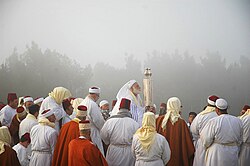
As of January 1, 2012, there are still 705 Samaritans living in Israel. Samaritans are not Jews (mainnly descendents of "Jew-dah") but they descend from other tribes of Israel that have intermarried with other nations.

Amazingly, till today they have been preserved as a remnant in the land of Israel.

Here they are, worshiping on Mount Gerazim


During his lifetime Jesus had a lot of interaction with Samaritans. He was definitely and distinctly a Jew, and came for the Jewish people, but I believe that  He also had a great heart and love for the Samaritans. We ought to pray for the Samaritan people today! When we read John 4, Luke 17, may we receive the heart of Yeshua for the Shomerim who also call upon the name of YHWH. 


Renouncing and Repenting Christian Terrorism

It isn't as if church history isn't clear enough that at many points in history, traditional Christianity has been one of the murderous and vile instigators of evil. 

Our "christian fathers " have killed the prophets, and today we adorn their graves. Meaning, that many "Christians" in times past were against Martin Luther King, the Civil Rights movement, and segregation, but the majority of Christianity today would say that if they lived during those days, they would have stood up for civil rights. We adore the Christians who died in the Holocaust, and say that if we were in their place, we would have done the same. But the fact is, the majority of evangelical Christians in Germany supported Hitler. 

http://www.bibliotecapleyades.net/mistic/religionsplanetearth11.htm

“National Socialism was a religion,” noted Professor George Lachmann Mosse of the University of Wisconsin-Madison, whose wealthy Jewish family fled Germany in 1933.


“The depth of the ideology, the liturgy, the element of hope, all helped to give the movement the character of a new faith. It has been shown that [Nazi propaganda minister Paul Joseph] Goebbels quite consciously used religious terminology in many of his speeches. Moreover, Nazism was a total worldview which by its very nature excluded all others.


From this it followed that traditional Christianity was a rival, not a friend. But here Hitler at first went very slowly indeed, for he needed (and got) the support of the majority of the Christian churches.”
Despite Nazi hostility to Christianity and thanks to Goebbels’s propaganda, many Germans believed that Hitler was heaven-sent.
 

A Cologne children’s prayer began,


“Fuehrer, my fuehrer, bequeathed to me by the Lord.”

And, with the notable exception of some anti-Nazi clerics such as Pastors Martin Niemoeller and the martyred Dietrich Bonhoeffer, the German congregations all fell into lockstep with the Nazi government.


Violent Christianity! Martin Luther promoted the following in his book, On the Jews and their Lies
  1. for Jewish synagogues and schools to be burned to the ground, and the remnants buried out of sight;
  2. for houses owned by Jews to be likewise razed, and the owners made to live in agricultural outbuildings;
  3. for their religious writings to be taken away;
  4. for rabbis to be forbidden to preach, and to be executed if they do;
  5. for safe conduct on the roads to be abolished for Jews;
  6. for usury to be prohibited, and for all silver and gold to be removed and "put aside for safekeeping"; and
  7. for the Jewish population to be put to work as agricultural slave labor.[4]
 
One such outstanding example is the Ku Klux Clan.  A quote has surfaced all over the internet, but I cannot find it's source. It was quoted here: http://answers.yahoo.com/question/index?qid=20080209170737AA7pm7H

"The hierarchy of the Ku Klux Klan was drawn exclusively from the hierarchy of the white Southern Baptist church. There were no Catholics, Jews or Jehovah's Witnesses in the Klan. There were a few Methodists in their ranks but their Kleagles, Exalted Cyclopses, Grand Wizards, etc., were all deacons, Sunday school teachers, ministers and preachers of that violent religion. The Klan was the enforcement wing of that white Southern Baptist church." ---http://www.mississippidays.com/murder

According to Wikipedia's pages on Christian Terrorism and also the KKK, 

Beginning after the Civil War, members of the Protestant-led[64] Ku Klux Klan organization began engaging in arson, beatings, cross burning, destruction of property, lynching, murder, rape, tar-and-feathering, and whipping against African Americans, Jews, Catholics, and other social or ethnic minorities.
They were explicitly Christian terrorist in ideology, basing their beliefs on a "religious foundation" in Christianity.[65] The goals of the KKK included, from an early time on, an intent to "reestablish Protestant Christian values in America by any means possible," and believe that "Jesus was the first Klansman."[66] Their cross-burnings were conducted not only to intimidate targets, but to demonstrate their respect and reverence for Jesus Christ, and the lighting ritual was steeped in Christian symbolism, including the saying of prayers and singing of Christian hymns.[67] Many modern Klan organizations, such as the Knights Party, USA, continue to focus on the Christian supremacist message, asserting that there is a "war" on to destroy "western Christian civilization."
  The Second Klan saw threats from every direction. A religious tone was apparent in its activities; "two-thirds of the national Klan lecturers were Protestant ministers," says historian Brian R. Farmer.[82] Much of the Klan's energy went to guarding "the home;" the historian Kathleen Bleeits said its members wanted to protect "the interests of white womanhood."[83]

Indiana's Klansmen represented a wide cross section of society: they were not disproportionately urban or rural, nor were they significantly more or less likely than other members of society to be from the working class, middle class, or professional ranks. Klansmen were Protestants, of course, but they cannot be described exclusively or even predominantly as fundamentalists. In reality, their religious affiliations mirrored the whole of white Protestant society, including those who did not belong to any church.[95]

The second Klan adopted a burning Latin cross as its symbol. No such crosses had been used by the first Klan, but the burning cross was used as a symbol of intimidation by the second Klan.[96] The burning of the cross was also used by the second Klan as a symbol of Christian fellowship, and its lighting during meetings was steeped in Christian prayer, the singing of hymns, and other overtly religious symbolism.[14]

I had never realized the normalcy of the KKK among many Christians. It was a Protestant movement! I feel convicted that the church has to "make full teshuvah". The KKK was really the tip of the iceberg after centuries of crusades, pograms, inquisitions, etc. We cannot afford to ignore the facts. We must face them, for only then can we be authentic followers of Christ,

1) Cry out to God for forgiveness for our pride, arrogance and selfishness
2) Utterly repent of, renounce, and turn away from racism, anti-semitism, Christian supremacy, and the pagan western-supremacist elements in our Christianity.
3) Ask for forgiveness from those we have offended.   
4) Pursue love and grace in our conduct. 
5) Spread awareness of the horrible history of Christian terrorism and antisemitism. Speak the truth about Church history!

Only then can we have a testimony in this world. How can we shine as lights if the world still accuses of the past misdeeds? The only way is for us to be completely broken over the wrong that is in the church! If only we would see as God sees