Wednesday, March 6, 2013

Media and Communications

I believe that media is an essentially neutral method of communication. It is neither good nor evil. However, since humans are generally imperfect, so are their communications. However, we see in times past that God was not opposed to media. In fact, the Bible was written on parchment scrolls and stone tablets with a Phoenician-based alphabet about the time when writing was fully developed.

Oral communication was the primary media in those days. However, the early church rote letters and had them delivered by hand, before there was any such thing as a postal service.

Later on in human history, Gutenberg invented the printing press. What was the first thing printed? The Bible.

Much later on in human history, the telephone was invented. And then the radio. And then the television. And then computers, and then the internet, and then, lo and behold, now we have social media like Blogger, Facebook, Twitter, and Youtube.

I have no reason to call these forms of communication "evil" simply because they are new. It is through these new forms of media that every single human being, good or bad, can express himself and communicate with the world. After all, the writers of the Bible kept up with the times very well.
The early church branched out and used Koine Greek for their communications, preferring globalization to isolationism.

What do we have today?
  1. Increased literacy and access to technology
  2. Increased breath of communication (global)
  3. Increased speed of communication
  4. Increased ease of communication.  
That  means that whatever message you want to put out, good or bad, can be quickly and easily communicated by anyone to everyone.

Social media today is what printing books and distributing them was yesterday. Now it's faster and easier. Like I said, I don't find any reason to reject modern communication. If I believed that human communication was dangerous, then I ought to, like the Amish, erect telephone shacks outside the house so that the "world" is kept at its distance.

Are we like the specific Pharisees whom Jesus criticized? (I mean no disrespect to Pharicism as a whole.) Do we think we're going to be more special and more holy by keeping off social media, and using letter-writing and telephone calls, which were novelties in their time? Do we think that we can be holy by keeping ourselves away from the "degenerate" world, and judge them for what they do? No, we don't judge unbelievers. We're supposed to judge those who are inside, the believers. 

Those who warn us to stay away from the people on social media are those who, 2,000 years ago, would have warned the disciples to stay away from the tax collectors, prostitutes, and Gentiles. 

We are responsible for our own righteous conduct. It is possible to be a disciple of Christ and use social media as part of your witness, in a very natural, organic way. If we're not on social media to participate in temporal pleasures and have fun, but to simply communicate and disseminate truth, then we are not in danger of being corrupted.

There is a danger when I say this, because of the cheapening and reduction of Christianity today, that some will take it as an excuse for drunkenness and revelry. Not so! I speak only of being a light in the midst of darkness, I do not speak of becoming darkness to reach darkness. There is still a great need for maturity, discernment, and walking by the Spirit.

Wednesday, February 27, 2013

200th Post!

Are we not His body,
Are we not His hands,
That were pierced,
His hand, to do His work?

Are we not His body,
That which was broken,
Poured out, the blood,
Given unto all men, for all men?

Are not we His feet,
That traveled miles to save a soul,
To which stricken sinners clung in depair,
Upon which their tears did flow.

Are we not His back,

That bore the blows
 that cleansed that world,

The stripes that set men free. 

Are we not His eyes,
That poured forth tears,
From His heart that broke with longing,
Shook with grief. 


Are we not His body,
To be who He is,
To do His work,
For those He loved - the world. 
 

Missions.

Every single disciple, every individual, every family, every church, is called to missions. We are in this world, not to be of this world nor to seclude ourselves from this world in fear of the world, but to complete God's mission in this world. Missions is not foremost about what we do, but who we are. Missions can be summarized in one thing: BE CHRIST UNTO THIS WORLD, or BE CHRIST UNTO OTHERS. Don't just point them to "that Christ" upon the cross - be to them, in every way, THE Christ who loved them and died for their salvation. 

Wednesday, February 20, 2013

The Greek Paraphrased NT

I think that'll be cool. There are so many Hebrew paraphrases of the NT, why not a Greek paraphrase to familiarize Greek beginners with the root nouns and their meanings? This could be a good exercise for students.

Joh 1:1-18 KJV
(1)  In the arche (beginning) was the Logos (Word), and the Logos was with Theos (God), and the  Logos was Theos.
(2)  The same was in the arche with Theos.
(3)  All things were made by him; and without him was not any thing made that was made.
(4)  In him was zoe (life); and the zoe was the phos (light) of anthropos (men).
(5)  And the phos shineth in scotia (darkness); and the scotia comprehended it not.
(6)  There was a anthropos sent from Theos, whose name was John.
(7)  The same came for a marturia (witness), to bear maturia of the phos, that all anthropos through him might pisteuo.
(8)  He was not that phos, but was sent to bear witness of that phos.
(9)  That was the alethinos(true) Phos, which lighteth every man that cometh into the kosmos (world).
(10)  He was in the kosmos, and the kosmos was made by him, and the kosmos knew him not.
(11)  He came unto his own, and his own received him not.
(12)  But as many as received him, to them gave the exousia (power) to become the teknon (sons) of Theos, even to them that believe on his onoma(name):
(13)  Which were born, not of aima (blood), nor of the thelema(will) of the sarx(flesh), nor of the thelema of aner(man), but of Theos.
(14)  And the Logos was made Sarx, and dwelt among us, and we beheld his doxa(glory), the doxa as of the monogenes (only begotten) of the Pater (father), full of charis (grace) and aletheia (truth).
(15)  John bare marturia of him, and cried, saying, This was he of whom I spake, He that cometh after me is preferred before me: for he was before me.
(16)  And of his pleroma (fulness) have all we received, and charis for charis.
(17)  For the nomos(law) was given by Moses, but charis and aletheia came by Jesus Christ.
(18)  Oudeis(nobody) hath seen Theos at any time; the monogenes uihos(Son), which is in the kolpos (bosom) of the Pater, he hath declared him.

Monday, February 18, 2013

Saved by Grace, Sanctified by Grace

I don't believe that we are saved by grace through faith and then sanctified through works, but rather the same act of grace saves us, and also sanctifies us by changing us and causing us to live in obedience to God. Grace compels us to take up our cross and follow Him. Works are not so much obedience to a "law" but to the direct command of God. The Law of God may provoke the evil in us while we remain sinners, but the command of God is life to the saints. Obedience is an action. Faith is trust. Faith is to walk in trust, and the way of trust is obedience.

God's grace is best described as God's benevolence, particularly as demonstrated in the justification of the sinner and in the reformation of the sinner, the complete rebirth into sainthood.

I believe that one can fall from God's benevolence, that one can so totally reject and harden one's heart so much so that God will reject one and harden His heart towards Him, as Scripture demonstrates. 

I believe in God's grace, I believe in God's benevolence that gives me the power by the Spirit to walk in righteousness, to receive the imparted righteousness. Some do not believe that God's grace sanctifies, that God's grace has only the power to justify sin but not to sanctify the sinner. That is not grace, and that is not salvation. Why would God only save a person in Spirit but neglect to save him in body and soul? Is God so incomplete?

I believe that God's benevolence that leads to salvation can never be taken for granted. Believed in, trusted, yes. Taken for granted, presumed upon, exploited, ravaged, manipulated - never! God forbid it to be so. 

Does God Help Those Who Help Themselves?

I'd like to believe so, even though the phrase comes from Greek philosophy. I could never believe in a faith practiced by one who does nothing, whose spirituality is so relaxed and reticent that nothing is required of the person.

I believe that God blesses and God provides, but surely not for the the slothful and expectant, not for those who think God owes them grace.

Christians always claim that, "We can't obey the law, so let's not even try". That is totally wrong! Does that  mean we go out and murder and steal and rape, simply because we can't be 100% righteous?

Does depending on God means waiting around for God? What about work, and diligence? What about plowing stony ground? What about sincerity? In a way, I am an Arminian. I don't believe that God by "hook or crook" preserves me against  my will, but that God's preservation is the power to persevere.  I believe that God cannot help us unless we first want to help ourselves and make the first steps to do so, or that God may want to help us, but if we will not be helped, then we will reject Him.

Friday, February 1, 2013

Fear and Evasion of Truth

"A Christian with faith has nothing to fear from facts; a Christian historian who draws the line limiting the field of enquiry at any point whatsoever, is admitting the limits of his faith. And of course he is also destroying the nature of his religion, which is a progressive revelation of truth. So the Christian, according to my understanding, should not be inhibited in the smallest degree from following the line of truth; indeed, he is positively bound to follow it." (Paul Johnson, A History of Christianity)


Thursday, January 31, 2013

Favorite Hymns of the Cross (6)


Take my life, and let it be consecrated, Lord, to Thee.
Take my moments and my days; let them flow in ceaseless praise.
Take my hands, and let them move at the impulse of Thy love.
Take my feet, and let them be swift and beautiful for Thee.

Take my voice, and let me sing always, only, for my King.
Take my lips, and let them be filled with messages from Thee.
Take my silver and my gold; not a mite would I withhold.
Take my intellect, and use every power as Thou shalt choose.

Take my will, and make it Thine; it shall be no longer mine.
Take my heart, it is Thine own; it shall be Thy royal throne.
Take my love, my Lord, I pour at Thy feet its treasure store.
Take myself, and I will be ever, only, all for Thee.

Wednesday, January 30, 2013

Favorite Hymns of the Cross (5)


Lyrics and Composer: B.B. McKinney, 1936
"Take up thy cross and follow Me," I heard my Master say;
"I gave My life to ransom thee, Surrender your all today."
Wherever He leads I'll go, Wherever He leads I'll go,
I'll follow my Christ who loves me so, Wherever He leads I'll go.


He drew me closer to His side, I sought His will to know,
And in that will I now abide, Wherever He leads I'll go.
Wherever He leads I'll go, Wherever He leads I'll go,
I'll follow my Christ who loves me so, Wherever He leads I'll go.


It may be thru' the shadows dim, Or o'er the stormy sea,
I take my cross and follow Him, Wherever He leadeth me.
Wherever He leads I'll go, Wherever He leads I'll go,
I'll follow my Christ who loves me so, Wherever He leads I'll go.


My heart, my life, my all I bring To Christ who loves me so;
he is my Master, Lord, and King, Wherever He leads I'll go.
Wherever He leads I'll go, Wherever He leads I'll go,
I'll follow my Christ who loves me so, Wherever He leads I'll go.


Not Idolatry, Not Blasphemy

It is not idolatry to believe that Jesus is God. You see, we agree with monotheists that God cannot be replicated by idols, images, sounds, etc., that God is beyond the replication of our senses. But God is not completely aloof either. We are not supposed to make anything of our own hands that is the image of YHWH. We cannot worship the works of our own hands. 

"God" is not the burning bush, not is the thunder "God", nor is nature "God'. I don't believe God is anti-physical or anti-natural or "corporeal" in a certain sense, but rather that God is above and beyond our natural world or physicality. Beyond rather than "Anti". Supernatural. God is more than noncorporeality. God is supercorporeality. 


But, the very first parsha of the Torah teaches us that God made Adam (Man) in His own image.

There it is plainly seen that the image of God can only be "replicated" by living flesh, and not just any flesh, but the flesh of a being made expressively by Him in His image out of the soil (adamah), namely, "Man".

But, it is only for God the Creator to make anything into His image. We cannot do the work of "replication" or "imitation". And that simply what God did in the person of Jesus Christ. His essence, His nature, and His image, was partially (not totally, for no one human being can bear the image of God) revealed to man. Jesus is not a "replica" but the physical embodiment of the "real thing", the "Word of God", the "Son of God" which came forth from God.  

The only perfect dwelling-place and "Temple" for God are human beings. That is the difference. We don't have idols in a temple what we worship as God. We bear the image of God - we are the "idol" in the sense of representing Christ to the world, and we are the Temple of the Holy Spirit of God who dwells in us.

"Christ in us, the hope of glory".

We are not "gods" or "demigods" on our own. Quite the opposite. We cannot be anything apart from God because who we are in Him derives completely from Him. We, human beings, cannot be worshipped apart from God as if the "Christ in  us" is a separate deity, because God is One, God is echad - a unity- one, comprehensive, and inseparable.

We, the Body of Christ, are the image, reflection, and bearer of God so long as we look only to Him and who He is, depending and trusting upon Him. The moment we look to our own selves, depending and trusting upon our own selves, we have cut ourselves off from God. In God, there is no "me", there is only "Him".

Bonhoeffer said, at the end of the Cost of Discipleship,

"It is only because He became like us that we can become like Him. It is only because we are identified with Him that we can become like Him. By being transformed into His image, we are enabled to model our lives on His. Now at last deeds are performed and life is lived in single-minded discipleship in the image of Christ on whom our gaze is fixed. The disciple looks solely at His Master..."

No matter how I try to explain, it is very difficult to explain without the possibility of my phrases becoming distorted and warped into some kind of heresy. No, I'm very Orthodox, Orthodox to the Whole of Scripture, even/especially the principles of Torah. May God take my every failure and inability of expression and turn it to nothing as He turns chometz into dust.

Burden for the Suffering

Around the world, many people are suffering. Often, we who live in comfort forget what it means to be in pain. We who eat full meals, have clothes to eat, and a loving and stable family environment, forget those who are hungry, who are destitute, and naked, and living in loveless and abusive situations.

Matthew 25 describes a scene at the end of days where many good, normal, Christians who profess the name of Jesus and call Him, "Lord", will end up suffering God's judgment because they neglected the suffering.

Who are the people at risk today? CNN.com often highlights their situations. Here are some descriptions of suffering in the world today that I have read recently.

1) Slaves. "Human trafficking" is another word for slavery. What did merchants do to people such as many Africans? Traffic them on ships against their will. Many are slaves today. Are we crying out to God to deliver them? Are we going to laud the graves of abolitionists while not speaking out the greedy moneymakers who prey upon the helpless? God forbid.

He has waged cruel war against human nature itself, violating it's most sacred rights of life and liberty in the persons of a distant people who never offended him, captivating & carrying them into slavery in another hemisphere, or to incur miserable death in their transportation thither. this piratical warfare, the opprobrium of infidel powers, is the warfare of the CHRISTIAN king of Great Britain. determined to keep open a market where MEN should be bought & sold, he has prostituted his negative for suppressing every legislative attempt to prohibit or to restrain this execrable commerce: and that this assemblage of horrors might want no fact of distinguished die, he is now exciting those very people to rise in arms among us, and to purchase that liberty of which he has deprived them by murdering the people on whom he also obtruded them; thus paying off former crimes committed against the liberties of one people, with crimes which he urges them to commit against the lives of another.
Many are not  only physically exploited, but sexually exploited. And many of them are children, against whom are done horrific deeds.


2) Children. Street children. Malnourished children. Starving children. Slave children. Beaten children. Abused Children. Children forced to work, to beg. Children working dangerous machinery in factories. Children who are disfigured, held captive against their will. Children without love and care in their lives, who end up in the wrong company and become criminals. Child soldiers. Child criminals. Young children forced into marriage. Orphans, living in mental institutions, abused, maltreated, unwanted. Children with impairments. Children killed by the ruthless and greedy. The list goes on.

3) Girls. Young girls, sold to older men as wife-slaves. Young girls, enslaved as prostitutes, helpless, violated. Young girls, raped and beaten and oppressed, given and bought and sold. Exploited, helpless little girls. Girls who know no other life than that of pain, rejection, instability.

4) Refugees. People without a home, without income, without property, fed with the barest of foods, without clean water. People who do not have the simplest sanitary needs met. People who die, simply for want of knowledge, living in ignorance and unnecessary suffering.

My friends, this is happening all around the world. God sees, God knows, and God cares. The thing is, can we identify ourselves with His sorrow? Let us not speak of social activism or work. Can we even tarry with Him one hour? Can we live as Christ, who was a man for others, who sacrificed all that was entitled to Him to die on the cross? What are we willing to sacrifice if we cannot even accommodate others, when we cannot even deny ourselves one simply want or pleasure.

We cannot accomplish a single thing unless we have learned to die to ourselves, our visions, our perception, our pleasure. We must be filled with the Spirit of God so that we can see as He sees and feel as He feels, because the suffering of man may be shielded from our view and thus easily forgotten, but not from the view of God. And we know that though we may not have direct "work" to do, we can only but do what work from which all works must derive - fall on our knees before God, pleading, crying out with holy desperation, groaning with the burden of such painful knowledge, pouring ourselves out in prayer out for the lost, dying, suffering, enslaved, oppressed before the face of the God-who-sees. 

Prayer is not simply "a thing in itself", an esoteric action to complete our spirituality. Intercession is for real, pressing, need.

Monday, January 28, 2013

Favorite Hymns of the Cross (3)

I Have Decided to Follow Jesus

1. I have decided to follow Jesus;
I have decided to follow Jesus;
No turning back, no turning back.

2. Tho' none go with me, I still will follow,
Tho' none go with me I still will follow,
Tho' none go with me, I still will follow;
No turning back, no turning back.

3. My cross I'll carry, till I see Jesus;
My cross I'll carry till I see Jesus,
My cross I'll carry till I see Jesus;
No turning back, No turning back.

4. The world behind me, the cross before me,
The world behind me, the cross before me;
No turning back, no turning back.

Sunday, January 27, 2013

Favorite Hymns of the Cross (2)

By Amy Carmichael


  1. From pray’r that asks that I may be
    Sheltered from winds that beat on Thee,
    From fearing when I should aspire,
    From falt’ring when I should climb high’r,
    From silken self, O Captain, free
    Thy soldier who would follow Thee.
  2. From subtle love of softening things,
    From easy choices, weakenings,
    (Not thus are spirits fortified,
    Not this way went the Crucified),
    From all that dims Thy Calvary,
    O Lamb of God, deliver me.
  3. Give me the love that leads the way,
    The faith that nothing can dismay,
    The hope no disappointments tire,
    The passion that will burn like fire,
    Let me not sink to be a clod:
    Make me Thy fuel, O flame of God.

Source: http://www.hymnal.net/hymn.php/h/418#ixzz2IzMx4Poq

Saturday, January 26, 2013

Favorite Hymns of the Cross (1)


  1. Many crowd the Savior’s kingdom,
      Few receive His cross;
    Many seek His consolation,
      Few will suffer loss.
    For the dear sake of the Master,
      Counting all but dross,
    For the dear sake of the Master,
      Counting all but dross.
  2. Many sit at Jesus’ table,
      Few will fast with Him,
    When the sorrow-cup of anguish
      Trembles to the brim.
    Few watch with Him in the garden,
      Who have sung the hymn,
    Few watch with Him in the garden,
      Who have sung the hymn.
  3. Many will confess His wisdom,
      Few embrace His shame.
    Many, should He smile upon them,
      Will His praise proclaim;
    Then, if for a while He leave them,
      They desert His name,
    Then, if for a while He leave them,
      They desert His name.
  4. But the souls who love Him truly,
      Let woe come or bliss,
    These will count their dearest hearts’ blood
      Not their own, but His.
    Savior, Thou who thus hast loved me,
      Give me love like this,
    Savior, Thou who thus hast loved me,
      Give me love like this.

A Man for Others?

There's nothing heretically liberal, or un"orthodox" or even humanistic about that phrase. It's not a "reinvention of Christ" or a rejection of His divinity.

I don't understand the problems many have when it comes to reading Bonhoeffer's early and later works. What was underlined, as it were, by Bonhoeffer throughout his life was the cross, the whole issue of "dying to self" and dying to more than self, without which it is impossible to understand "selflessness'. If you understand the underlining theme, the "underwater current", everything else is simple and straightforward and congruous.

What I love about reading certain books is their poetical flow, and their immense beauty of expression, especially when it comes to the cross.

I agree that Bonhoeffer grew in his beliefs, but can you really say that he completely changed his position from

"When Christ calls a man, He bid him come and die." (The Cost of Discipleship)

to

"The Church is her true self only when she exists for humanity " (Letters from Prison)

There is a connection between the two. It is a definite progression, not a regression.

Monday, January 7, 2013

New Monasticism


'...the restoration of the church will surely come only from a new type of monasticism which has nothing in common with the old but a complete lack of compromise in a life lived in accordance with the Sermon on the Mount in the discipleship of Christ.  I think it is time to gather people together to do this...' 
  -Dietrich Bonhoeffer

In the corridor of the Carmelite cloister a postulant stood before the imposing, black, crucifix that took up an entire wall's space. What was unique about this crucifix was that it was empty. The body of the sacred Christ did not hang from it. The Mother had explained to the postulant that the cross was empty because it was for you, the postulant, and you, the nun, to be symbolically crucified upon it and given to Christ.

How poignant! It is quite fair to compare discipleship with monasticism, both in similarity and difference.  


Is there any credence to "Yahshua" the name?

According to the research that I have done, I would like to clarify some teaching and understanding of Hebrew popular today. I believe I have found a plausible explanation of the name, "Yahshua"

1) Semitic languages
It is historically and linguistically clear that Semitic languages are very unlike our modern English, and so cannot be understood and interpreted in the same way. One vital key to understanding Semitic languages is this: Meanings are carried by consonants.Vowels are merely pronunciation aids, in a way. Words change drastically in spelling while the original meaning still remains. Let Wikipedia explain it:

The Semitic languages are well known for their nonconcatenative morphology. That is, word roots are not themselves syllables or words, but instead are isolated sets of consonants (usually three, making a so-called triliteral root). Words are composed out of roots not so much by adding prefixes or suffixes, but rather by filling in the vowels between the root consonants (although prefixes and suffixes are often added as well). For example, in Arabic, the root meaning "write" has the form k – t – b. From this root, words are formed by filling in the vowels, e.g. kitāb "book", kutub "books", kātib "writer", kuttāb "writers", kataba "he wrote", yaktubu "he writes", etc.
Despite the seemingly complete difference in the words "kitab" and "yaktubu" to our English eyes, they essentially carry the same root meaning. It is the same with the words "Islam" and "Muslim". It is the same in Hebrew (tzaddik, tzedek), and it is the same in Aramaic, and Ugaritic, and Syriac, etc. This is a primary feature almost unique to Semitic Languages.

Nonconcatenative morphology is extremely well developed in the Semitic languages, where it forms the basis of virtually all higher-level word formation (as with the example given in the diagram). This is especially pronounced in Arabic, where it is also used to form approximately 90% of all plurals; see broken plural.

 We must understand the whole concept of "nonconcatenative morphology". I believe that we must be intellectually honest when it comes to subjects such as ancient languges and that we must have a thorough understanding of what we are dealing with. Linguistics should not be played around with - we musn't go by "feeling" or by oversimplified logic.

2)Hebrew Construction
So, having established that vowels are not important and consonants are, we can understand that though the vowels for YHWH or YHVH has been lost, we still have the full essence of the meaning of His name.

We also must have a good understanding of Hebrew construction when it comes to names. The pattern that I have noticed that YH in the beginning of words is "Yeho" such in "Yehoshaphat" and at the end of words, it is "Yahu", such as in "Yeshayahu". Either way, the meaning of the root YH remains the same in its essence. This is the way it works in Hebrew. We must not understand Hebrew from the way English is written and spelt, and the way Hebrew is translated.

The "Ye" in Yeshua is pronounced with a "Tsere", which in Sephardi and Mizrachi, Hebrew, is pronounced the same as "e" not as "ei". In Tiberian Hebrew, which is an outdated but commonly printed pronunciation of Hebrew, "Tsere" is pronounced as "ei", making the name, "Yeyshua".

So far, I have not a dialect of Hebrew pronouncing the "Tzere" vowel "e" as "a", though, perhaps, Samaritan or Arabic Hebrew would pronounce it as such. That is plausible. I have heard that "Bereishit" in Samaritan Hebrew is "Barashit", so perhaps, some vowels considered "e" in Hebrew could be "a" in Samaritan Hebrew. 

 3) Arabic
And so we come to my conclusion. Let us compare some Hebrew names with their Arabic pronunciation. (I transliterated it from Google Translate)


Hebrew: YHWH (vowels unknown)
Arabic: Yehuwahu

Hebrew: Yehoshaphat
Arabic:Yehuwashephat

Hebrew: Yehudi
Arabic: Yahudi

Hebrew: Yeshua
Arabic: Yahsuwah

Hebrew: Ha-mashiach
Arabic: Al-masiyah

Aha! So it is, that those who pronounce Yah in Yeshua as Yahshua are actually using legitimate Arabic pronunciation. Which is fine, as long their remain authentic and drop the "h", making it "Yahsua". or "Yaswa"

See, it even goes along with the Arabic pronunciation, "Yahudi". I think a clear across-board application of a single vowel rule of pronunciation would be the way to go to avoid confusion. What I mean is, if you wish to go with the Arabic pronunciation, you should stick 100% to it, or with the Ashkenazi Hebrew pronunciation, stick with it.

So, instead of "shalom", "salam" would be the pronunciation that goes with "Yahsua". But please don't mix and match languages with something like "Shalam" or "Yahshua". When it gets to "Al-" and "Ha-" prefixes you would all tangled up in knots.

Also note that if you wish to change "Tzere" to an "A", "Elohim" must by necessity become the Syriac "Allaha" because the "e" in "Elohim" is a "Tzere".

Perhaps, perhaps, and maybe perhaps, the Aramaic pronunciation would shed some light. Arabic is a beautiful, complex, classical language worth learning well.

Shalom (or salam)!

UPDATE: Please read this excellent article by a real scholar, Dr. Daniel Botkin.


Monday, December 24, 2012

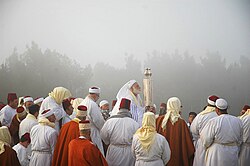
Samaritans Today

As of January 1, 2012, there are still 705 Samaritans living in Israel. Samaritans are not Jews (mainnly descendents of "Jew-dah") but they descend from other tribes of Israel that have intermarried with other nations.

Amazingly, till today they have been preserved as a remnant in the land of Israel.

Here they are, worshiping on Mount Gerazim


During his lifetime Jesus had a lot of interaction with Samaritans. He was definitely and distinctly a Jew, and came for the Jewish people, but I believe that  He also had a great heart and love for the Samaritans. We ought to pray for the Samaritan people today! When we read John 4, Luke 17, may we receive the heart of Yeshua for the Shomerim who also call upon the name of YHWH. 


Renouncing and Repenting Christian Terrorism

It isn't as if church history isn't clear enough that at many points in history, traditional Christianity has been one of the murderous and vile instigators of evil. 

Our "christian fathers " have killed the prophets, and today we adorn their graves. Meaning, that many "Christians" in times past were against Martin Luther King, the Civil Rights movement, and segregation, but the majority of Christianity today would say that if they lived during those days, they would have stood up for civil rights. We adore the Christians who died in the Holocaust, and say that if we were in their place, we would have done the same. But the fact is, the majority of evangelical Christians in Germany supported Hitler. 

http://www.bibliotecapleyades.net/mistic/religionsplanetearth11.htm

“National Socialism was a religion,” noted Professor George Lachmann Mosse of the University of Wisconsin-Madison, whose wealthy Jewish family fled Germany in 1933.


“The depth of the ideology, the liturgy, the element of hope, all helped to give the movement the character of a new faith. It has been shown that [Nazi propaganda minister Paul Joseph] Goebbels quite consciously used religious terminology in many of his speeches. Moreover, Nazism was a total worldview which by its very nature excluded all others.


From this it followed that traditional Christianity was a rival, not a friend. But here Hitler at first went very slowly indeed, for he needed (and got) the support of the majority of the Christian churches.”
Despite Nazi hostility to Christianity and thanks to Goebbels’s propaganda, many Germans believed that Hitler was heaven-sent.
 

A Cologne children’s prayer began,


“Fuehrer, my fuehrer, bequeathed to me by the Lord.”

And, with the notable exception of some anti-Nazi clerics such as Pastors Martin Niemoeller and the martyred Dietrich Bonhoeffer, the German congregations all fell into lockstep with the Nazi government.


Violent Christianity! Martin Luther promoted the following in his book, On the Jews and their Lies
  1. for Jewish synagogues and schools to be burned to the ground, and the remnants buried out of sight;
  2. for houses owned by Jews to be likewise razed, and the owners made to live in agricultural outbuildings;
  3. for their religious writings to be taken away;
  4. for rabbis to be forbidden to preach, and to be executed if they do;
  5. for safe conduct on the roads to be abolished for Jews;
  6. for usury to be prohibited, and for all silver and gold to be removed and "put aside for safekeeping"; and
  7. for the Jewish population to be put to work as agricultural slave labor.[4]
 
One such outstanding example is the Ku Klux Clan.  A quote has surfaced all over the internet, but I cannot find it's source. It was quoted here: http://answers.yahoo.com/question/index?qid=20080209170737AA7pm7H

"The hierarchy of the Ku Klux Klan was drawn exclusively from the hierarchy of the white Southern Baptist church. There were no Catholics, Jews or Jehovah's Witnesses in the Klan. There were a few Methodists in their ranks but their Kleagles, Exalted Cyclopses, Grand Wizards, etc., were all deacons, Sunday school teachers, ministers and preachers of that violent religion. The Klan was the enforcement wing of that white Southern Baptist church." ---http://www.mississippidays.com/murder

According to Wikipedia's pages on Christian Terrorism and also the KKK, 

Beginning after the Civil War, members of the Protestant-led[64] Ku Klux Klan organization began engaging in arson, beatings, cross burning, destruction of property, lynching, murder, rape, tar-and-feathering, and whipping against African Americans, Jews, Catholics, and other social or ethnic minorities.
They were explicitly Christian terrorist in ideology, basing their beliefs on a "religious foundation" in Christianity.[65] The goals of the KKK included, from an early time on, an intent to "reestablish Protestant Christian values in America by any means possible," and believe that "Jesus was the first Klansman."[66] Their cross-burnings were conducted not only to intimidate targets, but to demonstrate their respect and reverence for Jesus Christ, and the lighting ritual was steeped in Christian symbolism, including the saying of prayers and singing of Christian hymns.[67] Many modern Klan organizations, such as the Knights Party, USA, continue to focus on the Christian supremacist message, asserting that there is a "war" on to destroy "western Christian civilization."
  The Second Klan saw threats from every direction. A religious tone was apparent in its activities; "two-thirds of the national Klan lecturers were Protestant ministers," says historian Brian R. Farmer.[82] Much of the Klan's energy went to guarding "the home;" the historian Kathleen Bleeits said its members wanted to protect "the interests of white womanhood."[83]

Indiana's Klansmen represented a wide cross section of society: they were not disproportionately urban or rural, nor were they significantly more or less likely than other members of society to be from the working class, middle class, or professional ranks. Klansmen were Protestants, of course, but they cannot be described exclusively or even predominantly as fundamentalists. In reality, their religious affiliations mirrored the whole of white Protestant society, including those who did not belong to any church.[95]

The second Klan adopted a burning Latin cross as its symbol. No such crosses had been used by the first Klan, but the burning cross was used as a symbol of intimidation by the second Klan.[96] The burning of the cross was also used by the second Klan as a symbol of Christian fellowship, and its lighting during meetings was steeped in Christian prayer, the singing of hymns, and other overtly religious symbolism.[14]

I had never realized the normalcy of the KKK among many Christians. It was a Protestant movement! I feel convicted that the church has to "make full teshuvah". The KKK was really the tip of the iceberg after centuries of crusades, pograms, inquisitions, etc. We cannot afford to ignore the facts. We must face them, for only then can we be authentic followers of Christ,

1) Cry out to God for forgiveness for our pride, arrogance and selfishness
2) Utterly repent of, renounce, and turn away from racism, anti-semitism, Christian supremacy, and the pagan western-supremacist elements in our Christianity.
3) Ask for forgiveness from those we have offended.   
4) Pursue love and grace in our conduct. 
5) Spread awareness of the horrible history of Christian terrorism and antisemitism. Speak the truth about Church history!

Only then can we have a testimony in this world. How can we shine as lights if the world still accuses of the past misdeeds? The only way is for us to be completely broken over the wrong that is in the church! If only we would see as God sees  


Sunday, December 23, 2012

The World's Finger

"They are highly submissive to established authority, aggressive in the name of that authority, and conventional to the point of insisting everyone should behave as their authorities decide. They are fearful and self-righteous and have a lot of hostility in them that they readily direct toward various out-groups. They are easily incited, easily led, rather uninclined to think for themselves, largely impervious to facts and reason, and rely on social support to maintain their beliefs. They bring strong loyalty to their in-groups, have thick-walled, highly compartmentalized minds, use a lot of double standards in their judgments, are surprisingly unprincipled at times, and are often hypocrites."- Canadian psychologist, Robert Altemeyer.

 The world is pointing the finger at the church. They have much to contend with, and much to object against Christian fundamentalism. Are they wrong?

I believe that society's hatred of Christianity is largely justified. We have become traditionalists and legalists. Their objections are large not against Christ nor against His gospel but against the many, many, evils, or traditional Christianity.  

I have previously written on the "Fuhrer Prinzip", or the egocentric authoritarianism found in many, many, church groups and cults.

We are so inclined to worship a man, a teacher, and idolizing them. We become imitators of phrases and mannerisms. We respond to arguments with "typical" reasoning, trained and ingrained into our minds. The world is calling us hypocrites - how much more Jesus? We are walking according to the flesh - according to our carnal, irrational, subjective, closed and limited, minds and emotions. We are living the "Christian life" for our own selves. We fail to know Christ, because one needs to walk by the Spirit and not by the flesh.

Cult-like authoritarianism consists of two factors - a carnal, selfish, leader, and carnal, selfish, followers. They follow not after God but after a man.

But Jesus called them to Himself and said, "You know that the rulers of the Gentiles lord it over them, and their great men exercise authority over them. (Matthew 22:25 NASV)

 And 1st Peter 5 have more on the topic. It clearly states that leaders must not have the "I am the LORD, follow me" mentality.  

Anyway, just to summarize my thoughts.

Some of the things a "leader' must be:

1) An Imitator and disciple of Christ
2) The humblest of servants to all the flock.
3) Not one to "exercise authority" but to demonstrate godliness
4) Humble, repentent, and open about his own sins and failings
5) Encourage men not to be disciples of him alone and conform to his image, but of Christ over all.
6) Not greedy for money
7) 

There is no place for a dictator in the Kingdom of God. The assembly or congregation of saints is not a one-man show.

All of us must:
1) Have discernment
2) Be clear, truthful, and honest
3) Have a gentle, humble, spirit, not of course an arrogant and rebellious one
4) Know God the God's Word for oneself, and not depend on the "leader"
5) Have intellectual honesty (I stress on that a lot), not bury our heads in the sand, but know all the truth and all the facts
6) Not be reliant on exterior factors ("social support")
7) Free from loyalty and service to a man (idolatry)
8) Not be dependent on weak, repetitive, indoctrinated, arguments and phrases.
9) Take our beliefs to the extreme to mentally test their soundness. Absolute, rigorous, thinking!!!

Likewise, ye younger, submit yourselves unto the elder. Yea, all of you be subject one to another, and be clothed with humility: for God resisteth the proud, and giveth grace to the humble. (1 Peter 5:5)

Scripture is so balanced. Taken out of context, this can be a pretext for authoritarianism. Yet, if we all supremely care for others more than ourselves, to put others first and not our own gain, there will be perfect unity and oneness in Christ, not of the fleshly, selfish, kind found in most of Christianity. 

The world is not wrong to call Christians bigots because many times we really are intolerant and unloving. We can still be principled, however, and not be a religious, rigid, fundamentalist bigot.

Monday, December 17, 2012

With Christ, In School

I want so much to be Spiritual and to walk in the Spirit, yet not be accused of sloppy thinking and believing. I believe that God's divine power has given to us all treasures of wisdom and knowledge. Truly, all there is to know is Christ and Him crucified, because to know God is to know all things because all matter originates in His being.

I believe there are many examples of learned disciples of Christ, who were teachers, who spoke and wrote with clarity, whose minds were shaped by the Holy Spirit. That does not make them less intellectual, but far more so, in the right way. They do not depend on their own intellect, and thus, have the gift from God of knowledge and understanding beyond all that they are capable of.

What does it mean to be "With Christ, In School"? I want so much to be on the right track now, while I am still being educated. That means that the choices I make and the lessons I learn now, I want it worthwhile and of God. I don't want to look back on my education and regret, or have to "count it all loss". I want an education that is cross-centered, and I believe that that is possible, and far more, necessary.

God must be brought into every square corner of my life. His Words, His call to absolute obedience, must penetrate even the "earthly" parts of life, including education.

The growth of a disciple is laid out as such in 1st Peter 1: faith, diligence, virtue, knowledge, self-control, perseverance, godliness, brotherly kindness, and love.

Therefore, faith alone must be worked out with all diligence. Virtue, strength of character must accompany it, and also knowledge. Knowledge in a disciple is a great thing,  but it not enough to know, one must also have temperance and personal discipline. A complete education encompasses all these things.


And I end by quoting an old School-prayer taught to children.

Father of all! we return thee most humble and hearty thanks for thy protection of us in the night season, and for the refreshment of our souls and bodies, in the sweet repose of sleep. Accept also our unfeigned gratitude for all thy mercies during the helpless age of infancy.

Continue, we beseech thee, to guard us under the shadow of thy wing. Our age is tender, and our nature frail, and without the influence of thy grace, we shall surely fall.

Let that influence descend into our hearts, and teach us to love thee and truth above all things. O guard our hearts from the temptations to deceit, and grant, that we may abhor a lie as a sin and as a disgrace.

Inspire us also with an abhorrence of the loathsomeness of vice, and the pollutions of sensual pleasure. Grant at the same time, that we may early feel the delight of conscious purity, and wash our hands in innocency, from the united motives of inclination and of duty.

Give us, O thou Parent of all knowledge, a love of learning, and a taste for the pure and sublime pleasures of the understanding. Improve our memory, quicken our apprehension, and grant that we may lay up such a store of learning, as may fit us for the station to which it shall please thee to call us, and enable us to make great advances in virtue and religion, and shine as lights in the world, by the influence of a good example.

Give us grace to be diligent in our studies, and that whatever we read we may strongly mark, and inwardly digest it.

Bless our parents, guardians, and instructors; and grant that we may make them the best return in our power, for giving us opportunities of improvement, and for all their care and attention to our welfare. They ask no return, but that we should make use of those opportunities, and co-operate with their endeavours—O grant that we may never disappoint their anxious expectations.

Assist us mercifully, O Lord, that we may immediately engage in the studies and duties of the day, and go through them cheerfully, diligently and successfully.

Accept our endeavors, and pardon our defects through the merits of our blessed Saviour, Jesus Christ our Lord. Amen.


Sunday, December 16, 2012

Of Law, and then of Love

If our Christian life is still about what we can and cannot do, about what a true disciple does and does not do, then we are still living under "law". Our focus is not on love and obedience, it is on law and observance. It is about the flesh, and walking by the flesh. It is about judging others by what we see and perceive from our own experience.

Even if our Christian life from the point of view of the cross is about what we must suffer, what we must leave behind, about a set list of things we must give up, it is still missing something.  Discipleship is not a set course, or program. We are not members of a monastery. We are followers of Christ!

That leads to me to the point - love. Love is about obedience. It is about setting our eyes and mind of Christ. Our own sufferings, what we have given up to follow Christ, our nets, they have ceased. They have disappeared from our thoughts.

"Law" is when we look back at Sodom, when we groan about the "Egypt" we have left behind with its leeks and garlics, when we moan about manna and water. "Love" is when our eyes are set upon the Promised Land.

Without "love" we cannot understand God's Law, because at the heart of God's commandments was Love.

Jesus and the Pharisees. Two groups that practiced and believed almost the same thing. The imperceptible difference was that the focus of one was upon the Law of Love, namely the setting of our hearts upon God, and the other, the Law  itself. Note that the Pharisees loved God. Love was not absent from their belief and their practice. And note even more that Jesus was not antinomian. He did not command His disciples to murder and steal and to break as many laws as they could in some kind of libertarian defiance.

No.

"Do you still use the internet?"

"Do you still read secular books?"

These are probably not questions that stem from "love", but from "law".

What I mean by "law" is the kind of Christian life lived by observance of rules as opposed to allegiance to Christ.

It is ultimately about love, trust, and obedience. These are not contrary to the Law. If we truly understand the Bible then we know that love is the Torah. If we know Torah then we would understand Love. It our focus is fleshly, then we would react and say, "But that's not the only thing. Aren't we supposed to eat, to drink, to dress, to talk, in a certain way?"

The demands of Love, the demands of the Incarnate Jesus in person, the demands of a living God, will point a finger straight into the heart of the matter. Our fleshly evasions are to no avail.

Love is a heart, it is a perception. It we truly had that within us, quite naturally, the "things of the world will strangely dim."


Thursday, December 13, 2012

Creepy?

Perhaps now I now what it means for Christians near and far, in times past and present, to share one mind, that is, to have the mind of Christ.

When hearing Biblical preaching, teaching, and reading, I sometimes have this deep connection with the preacher so much so that I hear my own words coming forth from another's mouth, or know what preacher is going to saw before he says it. It's kinda creepy in a way, but perhaps that is what is meant by us "having the same mind".

Perhaps the common denominator is the preaching of the gospel of the cross. Regardless of vocabulary, language, emphasis or style of expression, the message is the same. And no matter what the topic, whether it is prayer, or the gospel, or love, or missions, it is the same!

It just resonates in me, in complete agreement with Scripture. It's this remarkable feeling I get, that is more than a feeling. It's an identification. And it's not merely emotions because it composes of the whole being, a united being, knitted together with the body of Christ and Christ Himself.

When you read the words of Jesus, or Paul, or John, or even teachers past and present that repeated them, and you have a sense of the fulness of what they are saying, and when you read those words out loud, they are almost your own words. It that's kind of understanding, the rich, amazing, comprehensive, understanding.

It is not the fault of the mind that people are deceived. They are deceived in their whole complete being! Their emotions, their mind, their conscience, their actions- everything lines up to support their own self-deception. And they refuse the truth but choose to waddle in ignorance like a sow in the mire.

1 Corinthians 1 speaks of Paul desiring that the entire church to be of one mind, to think, to judge, and to speak, as if they were one body. How entirely impossible! Yet so entirely so, if one walks according to the spirit.

The Jerusalem congregation, the first and original Messianic community, were gathered in one body. That is a high impossibility, knowing that the nature of God's people is that they are very individual, vocal, and passionate about their difference so much so that today, they cannot even agree on a Constitution. They will never be mindless cult-like followers, blinded and ignorant. No, above all they are true to their own self and have intellectual integrity. They do not conform for the sake of conforming. That is the nature of Am Yisroel. And when that people are joined together in such a depth of unity, it is something far more than superficial cloning. It is far from socialism. It is richer, it is deeper, it is supernatural, and yet, very organic. 

Christianity of the Gospels

The Christianity of the Gospels predates that of Pauline Christianity. One cannot have Paul's writings and take them to be all that Christian life is. Far from it! Everything Paul taught and said was build on the foundation of the apostles and prophets. It is impossible to have just Paul alone, for they build upon the Gospels and Words of Jesus, which proceeded naturally and completely from the Hebrew Scripture, the Torah and the Prophets.

What I appreciate about the "Cost of Discipleship" is that it's premise is the return to Jesus alone and His Word, to the core of our faith, to what it first was, without which the rest of the epistles become meaningless.

The "Cost of Discipleship" cannot be simply dismissed as "just one man's teaching" in the pejorative sense, because the whole book is about Jesus. It is also a plea for Christians to return to the Word of Jesus and to cast off all man-made dogmas, traditions, heresies, etc.

The Call of Jesus resurfaced in the 1930s through this book. Before, it had been forgotten and hidden, mentioned but not understood. Now all the dross was cast away and the  pressing issue, the heart of the matter, thrust into the faith of Christians - Christ demands obedience, absolute, single-minded obedience to His Word and His Word alone. Nothing less that absolute allegiance and adherence to Him, conformation to His image, and the death to all religious program.

Bonhoeffer was not promoting his own writing or interpretation. He wrote to direct men back to the Words of Jesus Himself. 

It is a call to the Narrow Way. 

Wednesday, December 12, 2012

Is Healthy Eating CONTRARY to God's Ways?

What would your answer be, that "Yes, because Jesus is healer". I find that too simplistic. The question is, perhaps, "Is my whole life consecrated to God as a living sacrifice and do all my actions deliberately reflect that?" Am I deliberate about what I eat, drink, and wear? 

The rule is Jesus First, Others Second, Yourself Last. Meaning, the rule regarding food is that it must firstly honor God, then be helpful to others, and lastly only nourish me.

I take eating a healthy diet the same as keeping God's moral commandments in this sense - Jesus is my Savior and the forgiver of my sins, and yet, I don't go out and murder and steal and wrong other people! That would make forgiveness cheap! Instead, I practice righteousness, knowing that my righteousness cannot save me.  In the same way, Jesus is my healer, and yet, I don't go out drink poison, and should avoid man-made foods that are just as good as poison in the long run! Instead, I practice wise nutrition and stewardship of my body, knowing that that cannot save me like Jesus can, but also knowing that I cannot ever take Jesus FOR GRANTED. My body is the Temple of the Holy Spirit, and all physical actions must correspond to that.

The question then is, in eating wisely, are we trusting God 100% or man? The same answer then would be, in obeying God and following Christ as disciples, are we trusting God's righteousness or our own obedience? Faith and obedience, trust and action are eternally inseparable. Jesus also said that if we are poisoned by snakes, we will not be harmed. In the same way, if we confess our sins, He will forgive us.

We don't walk by the flesh but by the spirit. But that by no means what occurs in the flesh does not count, but rather, the flesh must be a reflection and outworking of the Holy Spirit in me.

Meditating and thinking through Scripture avoids oversimplistic and ridiculous assumptions that will make the world mock Christians not because of the cross of Christ but because of our own lack of integrity and wisdom.

Tuesday, December 4, 2012

A Sharp Hit

A verse hit me sharply today. It is one of those texts of Bonhoeffer's, that he could meditate on for hours, seeking to grasp fully its meaning and implications.

"Therefore for him who knows to do good and does not do it, to him it is sin." (James 4:17)

I had memorized the book of James. Repeated it, over and over, but until today I had not really read that verse.

Today,after reading the headlines, going about my usual business, setting the corned beef to slow-cook, and sitting down to go through and review the book of James, mumbling and scanning through it, feeling guilty about not reading my Bible enough, suddenly, the verse hit me.

I repeated it again. I was stunned. Is that what it really means? Is that what it is saying?

This is one of those verses that  make you put down your Bible and reexamine your entire life. 

"Therefore for him who knows to do good and does not do it, to him it is sin." (James 4:17)

What excuse do I have?  That's it for me. I have to repeat this, over and over again. I have to put it into practice.


"Therefore for him who knows to do good and does not do it, to him it is sin." (James 4:17)

  1. Know - connotes perception, seeing, to look, to notice, to discern, to know, to be skilled in,
  2. Good - that which is beautiful, handsome, excellent, choice, surpassing, precious, useful, suitable, commendable, admirable, genuine, praiseworthy, noble, morally good, honourable, 
  3. Do - to make, produce, construct, form, fashion, author, cause, produce, bear, shoot forth, acquire, provide, render, constitute, declare, act rightly, do well, to carry out, to execute, to make ready, to perform
  4. Sin - to be without a share in, to miss the mark, to err, to be mistaken, to miss or wander from the path of  uprightness and honor, to do or go wrong, to wander from the Law of God, violate God's law, to commit an offence, a violation of the divine law in thought or in act
If I see anything that needs to be done, I have to do it!
If I, know, see, perceive and have discerned, and have the skill in, and notice, a need, which is useful, suitable, praiseworthy, and honorable, if I do not act rightly to make ready, carry out, perform, and execute it, I have missed the mark. I have wandered from God's Law.

This Law of God honestly should change my life completely.


Thursday, November 22, 2012

Legitimizing Damnation

That's what "cheap grace" is - damnation. To convince oneself that one is really safe and saved whilst on a bandwagon heading for a steep cliff. To throw oneself back into a raging river over and over again so that Christ may rescue you. To not only play with danger but to immerse oneself in it. To feign ignorance of the saving power of God's grace that leads men to repentance. To disbelieve God. 

There is no atonement without blood, and no salvation without sacrifice. And if truly understand the sacrifice of God that saves us, we would truly be saved. It we value the costliness of grace, then we tap into the power it releases to us.  

It is a self-deception to excuse oneself from obedience. To exclude obedience is to exclude faith.

Cheap grace is an attempt to separate the inseparable - the nature of God within Himself and His message: the gospel of salvation and the gospel of the cross. God cannot be divided, or conflicted. God is wholly One.  To separate God's holiness from His love is to have neither. To separate the salvation and the calling of God is to have neither either. It is a self-deception to believe that any other gospel save that of the cross is able to save.

The implications of the cross are twofold - that Christ died for our sins, and we died with Him. Christ went 100% for us, and calls us to go that 100% with Him.

There are only two possible life choices - light, faith, obedience, the narrow way, sacrifice, and salvation, or, darkness, unbelief, rebellion, the broad way, idolatry, and damnation. One have to decide between the love of God or the love of self. One have to choose between serving oneself or serving God.

There He bore: abandonment, loss, hardship, sorrow, sacrifice, suffering, grief, accusations, rejection, pain, and the burden of others' wrongs.

And He called us to follow Him, to forsake, as He did: life, riches, respect, the world, the cares of this life, the preservation of one's image, self, ambition, family, and career.

To receive, from what He bore, what He received: grace, blessing, life, glory, wisdom, peace, fulfilment, joy, and true liberty.

Self is a burden, a chain, and a hard yoke. To renounce oneself, to take up the cross, and follow Christ is to escape from bondage. The way of the cross is hard to those who receive it, but those who gladly follow Christ at His call will receive His gentle words and His grace. He asks nothing of us without giving us the strength to bear it.

If you live with the world,
You will perish with the world.
If you are married to the world, you will not escape the same judgment of God that will befall all sinners.
If you live as a sinner, you will die as a sinner, and be buried among sinners, and be burned with the rest of sinners.

God demonstrated His love by the cross. 

1) Love equals the cross.
2) Grace equals discipleship
3)  Missions equals forsaking one's nets to be a fisher of men.

Belief absolutely necessitates obedience.
Faith is to follow.

The religion "Christianity" should really be term, "Churchianity". The Sunday worship, the gifts or tithes, the religious observance, can be to a selfish man nothing more than an evasion of God. God must be our bread, our sustenance, upon whom we absolutely depend for our life, or He is nothing to us at all.

Again, Faith and obedience,
Redemption and the Cross are eternally inseparable
because they are central to the indivisible God. 

To be a Christian invariably means that this will be hard life because God's concept is always the Suffering before the Glory, the Shame before the Exaltation. This is not only the pattern of Christ's ministry on the earth and upon the cross, but the pattern laid out for all those who literally follow Him. 

 And why do we follow Him? Because with Him, and with Him alone, are the words of eternal life. No one can go to the Father except through Christ.  And He despised the shame. Are we ready to despise shame?

The Word of God births faith, and faith obedience, and obedience life. Sinful desire brings forth sin, and sin brings forth death. 

Sacrifice is only the inevitable corollary, not the purpose nor the goal nor the focus of our salvation. Sacrifice is a fruit of faith. Our goal is Christ, running towards Him with our eyes fixed ahead, our hands lifted above, and our hearts reaching out

 To separate love, grace, missions, etc. and all the Christian and Biblical issues from the cross is to remove all power and thus all salvation from God's Word, leaving us without God and without any Word at all. 

The selfish nature of man cannot be salvaged, let alone pampered. It is wedded to idolatry and to Satan. It has to be obliterated because it is incompatible with our union to Christ.

 There is not cross without the reality o God. Only a genuine encounter with Christ and an experience of His goodness will lead us to say, "Your goodness is better than life!" Life, the life that we leave behind, becomes of no importance because it is exchanged for something which is far better, the pearl of great price. Only when we meet Christ will we hear His call and receive the faith and grace to follow Him.  

There is no purpose to forsaking all if the forsaking of all is the end itself, without the reality of God and desire for God. It is empty, and meaningless. Nothing but Jesus Himself could call the young man to sell all he had, give to the poor, and follow Him. The cross is not the cross unless it is Christ who calls us to follow Him because of His immense love and grace and mercy.